


Best Semi-Automatic Espresso Machines in 2026: Features, Pros and Cons
|
|
Time to read 16 min
Your Cart
Your cart
Favorites





Shop by Brands

Shop by Brands
Shop by Brands


Shop by Brands


Shop by Brands
Shop by Brands
|
|
Time to read 16 min
The semi-automatic espresso machine you choose this quarter will run your coffee program for the next few years. That's a lot of mornings, a lot of milk drinks, and a lot of money flowing through one decision. Most buyers underestimate the weight of the call.
Getting it wrong is more common than people admit. The signs show up six months in, at the time of peak service. By then, the cost of switching outweighs the cost of living with it. Operators end up working around a machine that should have been working for them.
This guide gives you the frameworks and tips to avoid that outcome. You'll see the top picks for small café, high-volume, and home use, plus the criteria underneath each tier. By the end, you'll get a clearer shortlist of the best options for your needs.
The best semi-automatic espresso machine for you is the one matched to your daily output, not the most expensive in the lineup.
Single boiler suits low-volume home use, heat exchangers fit most prosumer and small-café setups, dual and multi-boilers are the standard for commercial service.
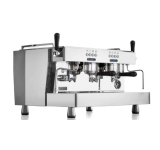
Compact one-group commercial machines like the Appia Life Compact and Rancilio Classe 5 S Compact give cafés professional shot quality without a two-group footprint.
Renewed and open-box options can cut 30 to 50 percent off list price on machines that have been deep-cleaned, performance-tested, and parts-replaced where needed.
Boiler type, group count, voltage, and after-sale support matter more than brand prestige once you start running shots every day.
A semi-automatic espresso machine handles water pressure and temperature for you, but leaves grinding, dosing, tamping, and shot timing in your hands. You press a button or flip a paddle to start extraction, and you stop it when the shot looks right.
That's the practical line between semi-auto and super-auto. Super-automatic machines grind, dose, tamp, and pour in one cycle. Semi-autos give you the control that defines specialty espresso, paired with the consistency of a pump and a stable boiler.
For commercial buyers, this matters because trained baristas need shot-by-shot control to dial in beans daily, lock the portafilter in, and adjust for milk drinks. For home prosumers, the semi-auto category is where a home setup really starts to look like a café bar.
Use these markers when comparing any two machines on a shortlist:

Boiler configuration that matches volume: Single boiler for solo home use, heat exchanger for small cafés and prosumers, dual or multi-boiler for high-volume service.
PID temperature control: Locks in shot temperature within tight tolerances. Standard on serious machines today.
Group head quality: E61 group heads or saturated groups deliver thermal stability. Avoid machines without a recognized group design.
Pump type: Rotary pumps are quieter and built for daily commercial use. Vibration pumps work well in home settings.
Build and serviceability: Stainless steel panels, real metal frames, and parts availability through the supplier. Plastic shortcuts show up in the second year.
Warranty and post-sale support: A 1-year parts warranty is the floor. Lifetime support and a tech you can actually call is the difference between a working bar and a dead machine on Tuesday morning.
Treat these markers as a filter you run any shortlist through. The right machine usually clears all. The wrong one tries to compensate for a missing marker with extras you don't need.
Tip: If two machines look identical on paper, compare boiler size and group head design first. Those two specs predict daily performance better than touchscreens or finish quality.
Semi-automatic isn't the only option in the category. Here's how it stacks up against the other machine types you'll see when comparing.
|
Machine Type |
Who Controls What |
Best Fit |
Trade-off |
|
Manual lever |
Barista controls pressure, flow, and timing by hand |
Specialty home, training labs, lever enthusiasts |
Steep learning curve, slowest workflow |
|
Semi-automatic |
Machine handles pressure and temp; barista starts and stops the shot |
Cafés, prosumer home, office bars |
Needs trained operator for best results |
|
Automatic (volumetric) |
Machine handles pressure, temp, and shot volume by program |
High-volume cafés with rotating staff |
Less shot-to-shot creative control |
|
Super-automatic |
Machine grinds, doses, tamps, and pours in one cycle |
Offices, convenience stores, hotels |
Lower shot quality ceiling |
Semi-autos win on the balance of control and consistency. Manual levers go further on craft but slow the bar down. Volumetric and super-auto machines hand more decisions to the machine, which works for high-traffic locations with mixed staff, but at the cost of shot-craft.
Here's how the standout machines compare across small café, high-volume, and home prosumer tiers.
|
Machine |
Best For |
Boiler Type |
Groups |
|
Compact café, cart, office |
Heat Exchanger |
1 / 2 |
|
|
Small café, hospitality |
Heat Exchanger |
1 / 2 |
|
|
High-volume café |
Heat Exchanger |
2 / 3 |
|
|
Specialty flagship, multi-boiler |
Multi-Boiler (PID) |
2 / 3 |
|
|
Prosumer, small café |
Dual Boiler (PID) |
1 |
|
|
Prosumer / light commercial |
Dual Boiler (PID) |
1 |
|
|
Serious home, small office |
Dual Boiler (PID) |
1 |
|
|
Home prosumer entry |
Single Boiler |
1 |
Compact one-group commercial machines have closed the distance to two-group setups for shops doing under 150 to 200 drinks a day. They cost less, draw less power, and free up bar space, while still delivering shot consistency at café scale.
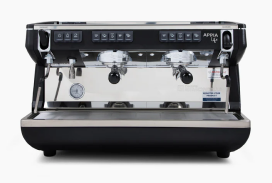
The Appia Life Compact is a heat-exchanger commercial machine with a pre-infusion chamber and Soft Infusion System, available in 1-group and 2-group compact builds. It runs on the same parts platform as the larger Appia Life models, sized for tight bars, carts, and office setups.
Key features
Heat exchanger boiler: Brew and steam at the same time without a wait, with 5L steam capacity on the 1-group.
Soft Infusion System: Reduces tamping inconsistency and produces more consistent extractions across baristas.
Pre-infusion chamber: Wets the puck at lower pressure before full extraction.
Four-hole steam wands: Stable microfoam in less time, which matters when milk drinks dominate the menu.
Pros
Trusted brand: Most coffee techs already know Nuova Simonelli parts and service.
Energy-efficient design: Uses 20% less energy than the previous Appia generation.
110V on the 1-group: Easier electrical install than most commercial machines.
Cons
One-group ceiling: Throughput caps during peak rush on the 1-group config.
Heat exchanger trade-off: Brew temp drifts under heavy steam load.
Skill needed: Heat exchanger workflow benefits from trained staff.
Best for: Coffee carts, kiosks, hotel bars, executive offices, and small cafés serving under 150 drinks a day.
Pricing: $4,400 (1-group) / $6,900 (2-group compact)
The Rancilio Classe 5 S Compact is a heat-exchanger commercial machine sized for coffee carts and tight back bars, available in 1-group and 2-group compact builds. The 1-group runs on 110V, which simplifies the install for cart and kiosk operators. A water-tank version (ST) with a built-in 4-liter reservoir is available for setups without a direct water connection.
Key features
Independent heat exchangers: Each group head pulls from its own heat exchanger for shot-to-shot consistency.
Steady Brew Technology: Available on 2-group and ST 2-group versions, holds water temperature steady across busy and slow periods.
C-Lever steam valve: Rancilio's patented ergonomic steam control with open-stay and open-close functions.
Water tank flexibility: ST version runs on a 4L internal tank for portable setups; standard version plumbs in.
Pros
110V install on the 1-group: Easier electrical setup than most commercial machines.
Two manual steam wands: Even the 1-group has dual wands for parallel milk work.
Cart-ready footprint: Designed for coffee trucks, kiosks, and small bar tops.
Cons
One-group throughput ceiling: Plan around peak rush before assuming compact is enough.
Steady Brew not on every config: The 1-group and 1-group tall don't get it.
12-month parts warranty: Shorter than some competitors at this price.
Best for: Coffee carts, kiosks, restaurants, hospitality venues, and small cafés that want a Rancilio commercial platform in a compact footprint.
Pricing: Inquire (1-group and 2-group compact configurations available)
High-volume cafés need throughput, thermal stability across simultaneous shots, and parts that don't disappear into a six-week back-order. The machines below cover the top tier.
The Aurelia Wave is a heat-exchanger machine running the Soft Infusion System, available in 2-group and 3-group builds. It's a fixture in specialty cafés worldwide, with a 14L steam boiler on the 2-group and 17L on the 3-group.
Key features
Heat-exchanger build with SIS: Designed for parallel service across both groups, with consistent extractions across baristas.
Cool-touch steam wand: Steam milk without burn risk on busy bars.
Raised group heads with lowered tray: Fits taller cups directly under the spouts.
Automated cleaning programs: Digital display lets baristas run cleaning cycles by group.
Pros
Proven at volume: Works under sustained morning rush.
Parts network: Easy to source service items and upgrades.
Strong barista trust: Many trained baristas already know the machine.
Cons
Heat exchanger limits: Dual boilers have an edge under extreme parallel use.
220V install: Requires a dedicated commercial circuit.
Footprint: Two- and three-group depth needs real bar planning.
Best for: Specialty cafés, third-wave shops, high-traffic urban locations.
Pricing: $9,950 (2-group) / $11,650 (3-group)
The Faema E61 Legend carries the legacy of the original 1961 E61 design, the machine that introduced the volumetric pump and 9-bar pressure to commercial espresso. Faema invented the E61 group and thermosyphon, and this Legend revival keeps that engineering DNA with modern Smart Boiler tech and a Thermal Balancing System.
Key features
Adjustable Thermal Balancing System: Fine-tunes temperature per group head to match the bean profile or single origin.
Smart Boiler tech: Maintains hot water and steam levels under peak demand without thermal dropout.
Volumetric pump at 9 atmospheres: The original Faema invention from 1961, still the industry pressure standard.
Available in 1GR and 2GR builds: $10,800 (6L steam, 1-group) and $11,970 (11L steam, 2-group).
Pros
Heritage build with current tech: Italian craftsmanship plus modern controls.
Per-group temperature control: Matters for shops running multiple coffees.
Cimbali Group parts backing: Strong service network through the Faema parent.
Cons
220V install: Both builds need a commercial circuit.
12-month parts-only warranty: Labor not included after the first year.
Long lead time on the 1GR: Ships in 12 weeks.
Best for: Cafés that value Italian engineering heritage and want per-group temperature flexibility.
Pricing: $10,800 (1-group) / $11,970 (2-group)
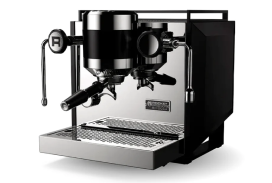
The Slayer Espresso V3 is the flagship of the lineup. It's a multi-boiler, semi-automatic machine with individual brew boilers per group, programmable PID adjustable in 0.1° increments, and Slayer's signature needle valve for restricted-flow extractions. Available in 2-group ($27,265) and 3-group builds.
Key features
Individual brew boilers per group: 1.7L per brew tank plus a separate 7.4L steam boiler on the 2-group.
Programmable PID in 0.1° increments: Precision temperature control for each group head.
Pre-infusion and needle valve: Restricted flow rate enables finer grinds and reduces channeling on single-origin shots.
Lever-actuated steam handles and shot mirrors: Built for hands-on workflow and visible extraction monitoring.
Pros
Thermal stability at scale: Multi-boiler design holds steady under heavy parallel use.
15-month parts and labor warranty: Plus free installation included.
Slayer flow control: The signature feature for specialty programs chasing a particular extraction signature.
Cons
Capital outlay: Highest price point in this guide.
8 to 13 week lead time: Built to order.
Skilled team needed: The capability is wasted on untrained staff.
Best for: Flagship specialty bars and high-end coffee programs with skilled baristas and brand positioning to justify the investment.
Pricing: $27,265 (2-group); 3-group available
For high-volume cafés that want a heat-exchanger workhorse instead of a multi-boiler flagship, the Rancilio Classe 9 S (2/3/4-group) and Classe 7 S extend the same Steady Brew platform upward.
Home buyers usually need shot quality first, then a footprint that fits a kitchen counter, then milk steaming that keeps up with a flat white or cappuccino habit. The picks below cover those three jobs across budgets, from an entry PID-controlled prosumer to a specialty single-group built for serious home programs and boutique bars.
The ECM Classika PID is a single-boiler, single-group machine with E61 brew group and PID temperature control. It's the lowest-priced unit in the lineup, and it delivers the build quality and shot stability that home buyers move up from entry-level pump machines to find.
Key features
Single-boiler dual-use design: Stainless steel boiler handles both brewing and steaming.
PID temperature control: Locks in brew temperature shot to shot.
E61 brew group with thermosyphon: Real prosumer group head at an entry price.
Mirror-finished stainless build: ECM build quality at the lowest price point in the lineup.
Pros
3-year parts and labor warranty: Rare at this entry price.
Easy maintenance: A single boiler means fewer service items.
Compact 10-inch width: Fits kitchens with limited counter space.
Cons
Wait between brew and steam: Single boiler limits back-to-back milk drinks (steam ready in 40 seconds).
15-minute warm-up: Longer than dual-boiler machines with fast heat-up.
Solo-user workflow: Not built for households running parallel drinks.
Best for: Solo or two-person households, low-volume kitchens, training rigs.
Pricing: $1,599
The Profitec PRO 600 Quick Steam runs independent stainless-steel boilers for brew and steam, PID control with shot timer, and the E61 brew group, all in a 12-inch-wide footprint. The Quick Steam valves speed up milk texturing between drinks.
Key features
True dual-boiler design: Independent insulated stainless-steel boilers.
PID controller with integrated shot timer: Tight thermal control plus timing visibility.
E61 brew group: Thermosyphon stability throughout the shot.
Fast heat-up mode and Quick Steam valves: Ready quicker than older E61 designs, with faster steam response.
Pros
Compact dual boiler: True dual at a 12-inch footprint and 52 lbs.
Mirror-finish stainless build: Internal steel frame prevents shipping damage.
Strong shot timer integration: Helps home users dial in consistently.
Cons
1L steam boiler: Sized for a few drinks at a time, not back-to-back service.
12-month parts warranty: Shorter than the R58's 3-year coverage.
Stock can move fast: Popular config that often runs low.
Best for: Couples or families pulling milk drinks daily, small-office coffee setups, prosumers wanting PID without crossing $3,000.
Pricing: $2,429
The Rocket R58 Cinquantotto is a dual-boiler, single-group machine with programmable PID, a commercial-grade rotary pump, and the option to plumb directly into a water line or run from the internal reservoir. Three years of parts and labor warranty puts it ahead of most prosumer competitors.
Key features
Dual boiler with programmable PID: Precise thermal control for brew and steam.
Commercial-grade rotary pump: Quiet and built for daily duty.
Plumb-in or reservoir flexibility: Works as a countertop machine or fixed install.
Saturated E61 group head: Direct connection to the boiler for stable temperature shot to shot.
Pros
Light commercial capable: Holds up well in offices and small private setups.
Long warranty: 3-year parts and labor is rare at this tier.
Communication Pod: Removable touchscreen with auto on/off scheduling.
Cons
One-group throughput: Limits parallel service.
Counter footprint: Larger than entry prosumer units at 11.8" wide.
Premium price: Steps up from compact home machines.
Best for: Serious home baristas, small offices, training rigs, light commercial use in private spaces.
Pricing: $3,500
The Slayer Steam Single is Slayer's prosumer entry, built for serious home baristas and small cafés. It runs on 110-120V with a 2.5L internal water tank (optional plumbing kit available), separate brew and steam boilers, and a 3-position manual actuator that programs up to 10 seconds of pre-infusion. Matte black with anodized aluminum panels, 18 inches wide.
Key features
Dual boiler with PID: 0.8L brew tank (900W) and 2.4L steam tank (2000W), each independently controlled.
Manual brew actuator with programmable pre-infusion: Hands-on pressure control plus up to 10 seconds of programmable pre-infusion you can save and replay.
Heads-Up Barista Dashboard: Real-time shot monitoring built into the machine.
Internal reservoir or plumbed install: 2.5L tank for plug-and-play, optional kit for permanent setups.
Pros
15-month parts and labor warranty: Slayer's standard coverage, longer than most prosumer competitors.
110V install: Works in any home or small bar without electrical upgrades.
Rotary vane pump: Commercial-grade pressure delivery in a prosumer footprint.
Cons
Premium price for one group: Capital goes into build quality, not throughput.
Specialty-focused workflow: Manual actuator rewards trained baristas; less forgiving for casual users.
2 to 4 week lead time: Not always immediate ship.
Best for: Serious home baristas, small specialty cafés, training labs, single-origin programs that don't need parallel service.
Pricing: $10,260
Picking the right machine comes down to several key factors. Here’s what you need to know:

Count drinks per day at peak, not average. A 200-drink shop with a one-group machine spends the morning fighting the bar. Plan for the rush, not the off-hour.
Single boiler is fine if you brew and steam separately. Heat exchanger covers most prosumer and small-café needs. Dual boiler is the safe call once daily volume crosses 100 drinks. Multi-boiler earns its price in flagship and high-volume specialty service.
One group fits home, carts, kiosks, and small cafés under roughly 150 drinks daily. Two groups handle 150 to 400 drinks daily. Three groups belong in high-traffic urban shops.
Most one-group commercial machines run on 110V or 120V. Two-group and larger units usually need 220V or 240V on a dedicated circuit, with wattage draw scaling alongside group count. Plumbed water lines beat reservoirs for any commercial install.
A respected brand without parts in your region is worse than a less famous one with overnight service. Ask about warranty depth, parts inventory, and tech support hours before you commit.
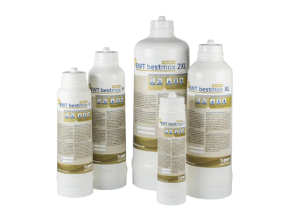
A commercial machine demands a commercial grinder. Water filtration is required by most manufacturer warranties, and untreated water voids coverage on every machine in this guide. Budget for tamper, knock box, milk pitchers, and cleaning supplies.
Renewed espresso machines from a serious supplier go through descaling, internal cleaning, performance repair, preventative parts replacement, and electrical safety testing before resale. Done right, they cut the entry price by 30 to 50 percent on machines that would otherwise be out of reach.
Both options work. The right choice depends on budget, risk tolerance, and how soon you need the machine on the bar.
Buy new when:
You're outfitting a new commercial location and need warranty depth from day one
You want the latest hardware revisions and the longest possible service life
Your buying decision depends on financing tied to a new-machine list price
Lead time isn't a constraint and you can wait for stock
Buy renewed or open-box when:
You want commercial-grade hardware at a home-prosumer price
You're replacing a unit and want to free up capital for a better grinder
You've reviewed the supplier's renewal process and warranty terms
The price difference funds something else in the setup
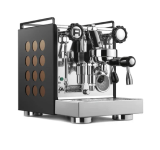
The Rocket Appartamento TCA Steel & White is a working example. Two units are typically stocked, an open box at $1,689 and a demo condition version at $1,699, both off a $2,250 list. Both are heat-exchanger machines with E61 group heads, a 4-setting temperature control system, 1.8L steam boiler, vibratory pump, and 110V install. Renewed and open-box machines through the renewed collection include a 12-month parts warranty after deep cleaning, performance repair, and electrical safety testing.
The best semi-automatic espresso machine isn't a single model. It's the configuration that matches your daily volume, your physical space, your team's skill level, and the support network behind the brand. A compact one-group like the Appia Life Compact is the right answer for a coffee cart. A two-group Aurelia Wave fits a busy specialty bar. A Slayer Espresso V3 belongs in a flagship program. Home prosumers land somewhere across the Classika PID, the PRO 600, and the R58.
If you're between two machines, weight your decision toward boiler type and group count first, then footprint and voltage, then brand parts availability. Brand prestige is the easiest variable to second-guess once those four are locked.
Pro Coffee Gear carries the new, open-box, and renewed semi-automatic machines covered in this guide, with financing, free U.S. shipping, and lifetime Pro Support across the catalog. Explore our semi-automatic espresso collection to filter by brand, boiler type, and group count, and book a free consultation if you want a second opinion before you buy. Stock on the popular dual-boiler and compact commercial models tends to move quickly through the spring buying window.
The Nuova Simonelli Appia Life Compact and the Rancilio Classe 5 S Compact are strong one-group commercial picks for cafés serving under 150 drinks a day. Both are heat-exchanger machines built on full commercial platforms, sized for tight bars, carts, and hotel setups.
For shot quality and customization, yes. Semi-automatic machines let trained baristas dial in extraction and milk texture daily. Super-automatics suit high-staff-turnover offices and convenience locations where speed and uniformity matter more than shot craft.
A heat exchanger uses one boiler with a separate brew-water pathway, so you can steam and brew at the same time. A dual boiler runs two completely independent boilers. Dual boilers give better temperature stability under heavy simultaneous brewing and steaming, at a higher price point.
Most one-group commercial machines run on 110V or 120V. Two-group and larger units typically need 220V or 240V on a dedicated circuit. Confirm voltage on the product page and with an electrician before ordering, since field conversions are expensive.
A semi-automatic espresso machine is only as good as the grinder paired with it, so the grinder should match the machine's daily volume and group count. Commercial setups need a commercial grinder with flat burrs sized for sustained service, while home setups can run smaller burrs without losing extraction quality.
For anyone making espresso drinks daily and serious about shot quality, yes. Semi-autos like the Classika PID, Profitec PRO 600, and Rocket R58 deliver café-grade hardware in a kitchen footprint, with the control that defines specialty espresso.
Our team can help you find the best fit based on your space, volume, and budget.
Talk to a Specialist

