


Rocket Commercial Espresso Machines: Performance, Quality & Features
|
|
Time to read 16 min
Your Cart
Your cart
Favorites





Shop by Brands

Shop by Brands
Shop by Brands


Shop by Brands


Shop by Brands
Shop by Brands
|
|
Time to read 16 min
Stepping into a busy café or managing a high-volume coffee bar, you know that every second counts and every cup matters. The right espresso machine can be the difference between smooth service and constant bottlenecks, or between consistent flavor and disappointed customers. For café owners, bar managers, and specialty coffee operators, finding equipment that matches both your workflow and your menu demands feels overwhelming.
Machines that underperform or fail during peak hours can disrupt your business and frustrate your team. In this blog, we will guide you through Rocket Espresso Commercial machines, helping you choose the right fit for your café’s needs.
Rocket commercial espresso machines offer precise temperature and pressure control for consistent, professional-quality espresso.
Choose machine group count based on peak-hour volume, not average daily drinks, for workflow efficiency.
Proper bar layout, steam wand placement, and milk workflow improve service speed and drink consistency.
Water filtration, plumb-in planning, and electrical setup are critical for long-term reliability and performance.
Regular maintenance, preventive inspections, and downtime planning extend machine lifespan and reduce operational disruptions.
Choosing a commercial espresso machine affects workflow, drink consistency, and business efficiency. The criteria below reflect operational realities in high-use environments and align with US service standards.
Daily Drink Volume and Peak-Hour Pacing: Estimate your average drinks per day and peak-hour throughput. Higher volumes require systems that maintain temperature and pressure under continuous demand, reducing queue bottlenecks.
Milk Menu Intensity (Cappuccino/Latte Share): Define the percentage of milk-based drinks you serve. Machines with robust steam capacity handle sustained milk texture demands more effectively, reducing wait times and steam recovery stress.
Boiler Design Implications For Brew/Steam Recovery: Boiler architecture determines how quickly a machine can transition between espresso extraction and steaming. Dual boilers or multi-boiler systems sustain stable temperatures and independent brew/steam functions under load.
Group Count Choice As A Throughput Tool: One group suits lower volume or space-constrained setups. Two or three groups increase simultaneous extraction capacity, facilitating faster service during peak periods.
Service Access: Parts, Technician Workflow, Maintenance Cadence: Consider the accessibility of parts and qualified service technicians in your region. Routine maintenance cadence, daily backflushing, and periodic gasket replacement affect downtime planning and long-term reliability.
Before You Choose A Model, Collect These Numbers
Expected Drinks/Day
Peak Hour Drinks
% Milk Drinks
Available Counter Width/Depth
Power Availability (Confirm With Electrician)
Plumb-In Feasibility
Also Read: Finding the Best Espresso Grinder for Home Use
Before narrowing down to a specific model, gather these essential numbers to ensure your choice aligns with your café’s workflow and volume.
Commercial espresso specifications only matter when they improve speed, consistency, and control during service. This section connects commonly highlighted technical features to how they affect real café operations, barista workflow, and drink quality across busy service windows.

Below are the core commercial features and how they translate into daily operational value.
Boiler architecture defines how a machine manages heat under continuous use. In commercial environments, this directly affects shot repeatability, recovery behavior, and how forgiving the machine is during back-to-back orders.
Below are the practical implications of common boiler and temperature control designs.
Dual Boiler Systems Explained: Separate boilers manage brewing and steaming independently, allowing consistent brew temperatures even during heavy milk service without thermal interference.
Multi-Boiler Systems Explained: Individual boilers per group maintain localized temperature stability, supporting consistent extraction across simultaneous shots during peak demand.
Saturated Group Head Design: Brew groups integrated with the boiler mass reduce temperature fluctuation between shots, improving thermal consistency during extended service periods.
Temperature Stability In Practice: Stable water temperature supports repeatable extraction across different baristas, reducing recipe drift and minimizing adjustments during rush hours.
Steam performance determines how quickly milk drinks move from order to pass. In milk-forward menus, steam characteristics influence texture quality, workflow speed, and barista fatigue across long shifts.
Below are the steam-related features that impact cappuccino service efficiency.
Dry Steam Output: Dry steam contains less residual water, enabling faster milk stretching and finer microfoam texture, which improves consistency and reduces reheating time.
Steam Pressure Stability: Consistent pressure supports back-to-back milk preparation without noticeable performance drop, critical during high cappuccino volume periods.
Cool-Touch Steam Wands: Insulated wands reduce burn risk, improve cleaning speed between drinks, and support safer operation in fast-paced service environments.
Multi-Tasking Capability: Strong steam systems allow simultaneous milk preparation and espresso extraction without workflow bottlenecks
Consistency tools reduce dependence on manual timing and visual judgment during busy service. Below are the shot management tools that support operational consistency.
Volumetric Or Programmed Dosing: Automated shot volumes stop extraction at preset levels, reducing variability caused by manual intervention and improving consistency across multiple baristas.
Shot Timers For Extraction Awareness: Integrated timers provide immediate feedback on shot duration, helping identify grind or dosing issues without interrupting service flow.
Display-Based Feedback Loops: Visual indicators support faster decision-making during peak hours, allowing baristas to monitor extraction performance at a glance.
Reduced Cognitive Load During Rush: Automation and clear feedback minimize mental strain, allowing focus on milk quality, customer flow, and order accuracy.
Understanding these features helps you see how each model translates into practical performance. Now, let’s look at the specific machines available.
Rocket’s commercial lineup includes multiple configurations designed to support sustained service, diverse menus, and varied space constraints. Below are the commercial categories and how they correspond to machine capabilities, followed by detailed model breakdowns.
Who It Fits
Operators needing a compact commercial footprint that supports regular service environment demands without occupying excessive counter area. Particularly suited for smaller cafés, carts, or venues where floor space is limited but throughput and reliability remain priorities.
What To Know
Heat-exchanger boiler design with thermosiphon circulation provides stable brewing conditions.
Integrated volumetric shot control and built-in shot timer support consistent extraction outputs across shifts.
Cool-touch steam wands provide safer handling under continuous use.
Available in 1, 2, or 3 group configurations, allowing you to align group count with service demand.
Workflow Notes
The thermosiphon system maintains thermal stability between extraction cycles, aiding workflow during sustained orders.
Volumetric dosing buttons reduce manual intervention, freeing baristas' focus during simultaneous drink builds.
Cool-touch steam wands minimize downtime between milk steaming tasks, supporting smoother service pacing.
Specs To Confirm On The Product Page
Dimensions: 1 group approx. 18.9" W × 19.29" D × 18.5" H; 2 group and 3 group widths increase accordingly.
Boiler Capacity: 8.3 L (1 group), 13.2 L (2 group), 23 L (3 group) (approx).
Voltage and Power: Typical commercial supply requirements for group configuration (confirm exact values).
Weight: Varies by group count (approx 102 lbs for 1 group; up to 162 lbs for 3 groups).
Who It Fits
Cafés and restaurants with medium to high service volume that require independent brew and steam control, precise temperature stability, and enhanced throughput across sustained business hours.
What To Know
Dual boiler architecture separates brew and steam systems for uninterrupted simultaneous extraction and steaming, supporting consistent performance under load.
Built‑in volumetric controls and programmable shot settings automate shot volumes, reducing variability across shifts.
Saturated groups maintain thermal stability from the boiler to the group head.
Electronic temperature control with PID and a 4.3″ TFT service display supports accurate temperature management and easier operational adjustments.
Cool‑touch stainless steel steam wands aid staff comfort and cleaning during sustained milk drink service.
Workflow Notes
Dual boilers ensure consistent shot quality during peak demand, allowing extraction and steaming to occur without thermal interference.
Saturated group heads reduce temperature drift between shots, improving extraction repeatability.
TFT display enhances operational visibility for settings and error prompts, reducing guesswork for staff.
Adjustable dual‑level drip trays accommodate a range of cup sizes without disrupting flow.
Specs To Confirm On The Product Page
Boiler Type: Dual boiler system with separate brew and steam sections.
Group Heads: Available in 2 or 3 group configurations.
Steam Boiler Capacity: Typically ~9 L (2‑group) to ~14 L (3‑group).
Dimensions: ~29.9″–38.6″ L × 23.2″ D × 21.1″ H, depending on group count.
Voltage & Power: ~208–240 V service supply and ~4300 W–5250 W (confirm exact values per variant).
Who It Fits
Cafés and coffee bars that require repeatable precision, high heat stability, and ergonomic workflow for back‑to‑back drink service. This model supports multi‑group configurations with advanced controls suited for moderate to high daily volumes and specialty drink menus where consistency and barista ergonomics are priorities.
What To Know
Lower overall machine height improves barista–customer interaction and sightlines across the counter.
Independent PID temperature control for each brew group helps maintain exact brew temperatures and supports varied coffee profiles.
Multi‑boiler system with fully saturated group heads supports stable extraction and rapid recovery under heavy use.
Built‑in shot timers and digital group displays give clear extraction feedback during service.
Workflow Notes
Ergonomic Control Cluster: Lower‑set control interface places brewing controls within easy reach, reducing barista fatigue and improving workflow rates.
Pressure Transducer Steam Recovery: Enhanced steam recovery reduces wait time between milk steaming and next brew cycle, sustaining throughput during peak periods.
Separate Group Parameters: Storing individual brew parameters per group head supports training consistency across shifts, helping staff reproduce recipes accurately.
Specs To Confirm On The Product Page
Group Count Options: Available in 2, 3, and 4 group configurations.
Multi‑Boiler Dimensions: Typical width 29.9″–47.2″ depending on group count; depth ~23.2″; height ~19.6″.
Boiler Capacity: Multiple independent brew boilers (1.9 L each) plus a larger steam boiler (9 L–12 L).
Power Requirements: Voltage and power vary by configuration (confirm exact values per variant).
Who It Fits
Commercial cafés and specialty coffee bars require full control over extraction variables and demand repeatable flavor precision across diverse roast profiles. This machine supports operators who balance high-volume service with programmed shot preferences and advanced extraction techniques.
What To Know
Multi‑Boiler With Saturated Groups: Independent brew boilers for each group head maintain consistent temperature at the group, crucial for repeatable extraction across shots.
Programmable Pressure Profiling: Offers five preset profiles plus a semi‑automatic mode to shape pressure curves throughout extraction, enhancing flavor clarity and consistency.
PID Temperature Control: Precise boiler temperature regulation supports stable steam pressure and brewing conditions under continuous service.
Volumetric Shot Programming: Enables automated shot volumes, reducing manual variability and supporting consistent throughput.
Workflow Notes
Per‑Group Digital Display: Shows shot timing and extraction parameters for each group, aiding baristas in monitoring quality during peak demand.
Programmable Profile Adaptation: Baristas can store successful pressure profiles and recall them for specific beans or roast styles, reducing setup time for specialty offerings.
Touchscreen Control Interface: Displays real‑time brew variables and supports intuitive adjustments during service, helping teams maintain consistency.
Extended Steam Capability: Cool‑touch steam wands handle frequent milk drink demands without downtime between steaming tasks.
Specs To Confirm On The Product Page
Boiler Configuration: Multi‑boiler with independently saturated group brew boilers (1.9 L each) and a separate steam boiler (9 L for 2 group; 12 L for 3 group).
Dimensions: Typical widths ~29.9″ (2‑group) and ~38.6″ (3‑group), depth ~23.2″, height ~22.75″.
Voltage & Power: 220 V with power ranges of ~5600 W (2‑group) and ~7400 W (3‑group).
Control Interface: Digital group displays for shot timing and temperature readouts, and programmable profile interface.
Who It Fits
Operators seeking a premium, feature‑rich single‑group solution for shared spaces, office coffee bars, or lower‑volume commercial counters that still demand advanced control over extraction and temperature stability. This machine bridges compact footprint needs with sophisticated digital interfaces and programmability.
What To Know
Dual Boiler Configuration: Separate brew and steam boilers maintain stable temperatures, enabling simultaneous espresso extraction and milk steaming without thermal interference.
Touchscreen Interface: 3.5″ touchscreen on the group head offers direct access to settings such as volumetric controls, boiler readouts, and operational adjustments.
PID Temperature Regulation: Electronic PID control supports precise brew and steam temperature management for enhanced consistency.
Plumb‑In Ready or Tank Option: Equipped with a rotary pump that accommodates either internal reservoir use or a direct plumb‑in setup for uninterrupted operation in a commercial space.
Workflow Notes
Touchscreen Program Controls: Interactive screen allows programming of shot volumes, boiler set points, and energy scheduling without external menus or buttons, promoting simplified workflows across shifts.
Heat‑Up And Temperature Control: Dual boiler and active PID systems reduce heat fluctuations, supporting reliable extraction from the first shot to the last in a service session.
Plumb‑In Flexibility: Ability to use a water tank or hard‑plumb setup aids installation planning for diverse café or office environments, reducing refill interruptions.
Specs To Confirm On The Product Page
Boiler Type: Dual stainless steel (brew + steam) configuration.
Display Type: 3.5″ touchscreen HMI showing boiler data and operational parameters.
Dimensions: ~16.1″ W × 18.3″ D × 15.7″ H.
Voltage & Wattage: 110 V with ~1600 W power.
Weight: ~77 lbs (35 kg).
Who It Fits
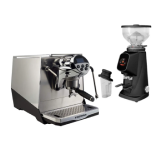
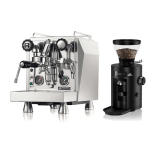
Cafés and specialty bars that want a complete espresso station solution, pairing a Rocket commercial machine with a high‑performance grinder engineered to match throughput, dosing precision, and workflow speed in busy service environments. These bundles help reduce setup mismatches between machine and grinder capacity.
What To Know
Included configurations combine the Rocket Boxer Timer Evo commercial espresso machine with your choice of Macap Supra or MI40 Luxe commercial grinder, creating a balanced station suited for medium to high‑volume service.
Macap Supra grinders offer large flat burr sets (up to 83 mm), fast grinding speeds (up to ~10 kg/hr), and a customizable interface for programmable dosing and recipe management.
Macap MI40 Luxe grinders include 65 mm flat burrs with a precise stepless adjustment dial and intuitive touchscreen for dose programming and grind control, supporting consistent espresso extraction.
Workflow Notes
Paired machines and grinders ensure dose and grind speed scale with service demands, minimizing bottlenecks between bean delivery and extraction.
Grinder interfaces with programmable dose, reducing cycle time and ssupportingrepeatable settings across shifts.
High‑speed flat burr sets buffer dose flow during peak hours without excessive heat generation that can affect grind quality.
What To Evaluate In A Commercial Grinder Pairing
Dose Consistency: Electronic dosing systems deliver repeatable gram‑level doses and reduce variability between baristas.
Speed: Commercial grinders with high burr speeds and large burr diameters reduce wait time between drinks and better match multi‑group machine throughput.
Burr Suitability: Flat burr designs and quality construction improve particle distribution uniformity, promoting balanced extraction and crema quality.
Adjustment Control: Micro‑adjustable or stepless grind systems allow precise tuning across bean types and roast levels, supporting stable service quality.
What To Confirm
Grinder Burr Size and Type: Confirm burr diameter and whether flat or conical burrs are used, as this affects grind speed and particle consistency.
Grind Speed (g/sec): Check the grinder’s output rate to ensure it can keep up with expected drink volume during peak service.
Dosing Modes: Verify available dosing modes (programmable, manual, weight‑based) for workflow consistency.
Hopper Capacity: Larger hoppers reduce refill frequency during service.
Maintenance Accessibility: Look for easy access to burrs and parts for cleaning and routine service.
Bundles like these provide an integrated commercial workflow designed to deliver consistent dosing, matched throughput, and paired feature sets that support busy café environments without mismatches between machine and grinder performance.
Before we break down the comparison table, let’s quickly review the full list of Rocket commercial espresso machines you can consider.
Commercial espresso buyers benefit from seeing all Rocket machine options at a glance. This table consolidates group counts, boiler types, pressure profiling, control interfaces, and best-fit use cases into one view to simplify decision-making and workflow planning.
Here are the details pulled directly from Pro Coffee Gear product pages:
|
Model |
Group Count Options |
Boiler System Type |
Profiling |
Control Interface |
Best Fit Use Case |
|
1, 2 |
Dual Boiler |
No |
Buttons, Levers |
Space-limited bar or cart |
|
|
1 |
Dual Boiler |
No |
Buttons, Shot Timer |
Space-limited bar or cart |
|
|
2 |
Dual Boiler |
No |
TFT Display, Buttons |
Standard café menu, milk-forward drinks |
|
|
2 |
Dual Boiler |
No |
TFT Display, Buttons |
Standard café menu, milk-forward drinks |
|
|
2, 3, 4 |
Multi-Boiler |
No |
Digital Display, Buttons |
Specialty program needing profiling |
|
|
2, 3, 4 |
Multi-Boiler |
No |
Digital Display, Buttons |
Specialty program needing profiling |
|
|
2, 3 |
Multi-Boiler |
Yes |
Digital Display, Touchscreen |
Specialty program needing profiling, lighter roasts |
|
|
1 |
Dual Boiler |
Yes |
Touchscreen |
Office, shared space, low-volume premium counter |
|
|
2 |
Dual Boiler |
No |
Buttons, Shot Timer |
Standard café menu, high-volume bar |
Also Read: A Guide to Different Types of Coffee Makers and Brew Methods
With the comparison table in view, you can now start matching the right Rocket machine to your expected drink volume and workflow needs.
Selecting the right Rocket commercial espresso machine requires careful consideration of daily drink volume, peak-hour demand, and menu composition. Below are practical volume‑based guidelines for matching machine group counts to operational needs:
Under ~150 Drinks/Day – 1 Group or Compact 2 Group
Ideal for low-volume cafés, office bars, or specialty counters.
Supports moderate milk steaming needs with minimal simultaneous extraction.
Reduces space footprint and energy consumption while maintaining quality.
~150–300 Drinks/Day – 2 Group Typical Planning
Balances espresso and milk-heavy menus efficiently.
Allows simultaneous extraction on one group while steaming milk on another.
Supports multiple baristas or quick service during short peak periods.
Over ~300 Drinks/Day – 3 Group Planning
Designed for high-volume cafés, busy lunch service, or large catering operations.
Multiple groups allow simultaneous extraction and steaming, maintaining workflow pace.
Reduces wait times for customers and prevents bottlenecks in high-demand periods.
Peak-Hour Logic
Plan for simultaneous extraction and steaming; each group should have dedicated access to boiler capacity.
Consider machine recovery time and milk steaming efficiency to avoid service delays.
Tie group count to menu composition: milk-heavy menus benefit from additional groups and high-capacity steam boilers.
Once you’ve aligned machine capacity with drink volume, it’s time to focus on cappuccino service, milk workflow, and efficient bar design.
Cappuccino-focused service demands more than strong espresso output. The way steam, milk movement, and bar layout work together directly affects speed, consistency, and drink quality during busy service windows.

Below are the key considerations for milk-heavy service planning:
Steam Wand Distribution Strategy: Position steam wands based on milk volume per station rather than total group count to prevent bottlenecks during rush periods.
Dedicated Milk Prep Zones: Establish a clear movement path from refrigeration to steaming to reduce congestion and improve preparation speed.
Bar Flow And Clearance Planning: Allow adequate spacing around steam wands to support simultaneous use without interfering with neighboring tasks.
Dry Steam Utilization: Use low-moisture steam output to create stable microfoam while reducing excess water dilution in milk.
Temperature Consistency Control: Maintain steady steam performance to ensure repeatable milk texture across consecutive drinks.
Spill And Cleanup Management: Designate splash zones and easy-clean surfaces near steam areas to minimize downtime and maintain presentation standards.
Workflow Efficiency For Peak Hours: Organize milk handling steps to reduce backtracking and allow multiple baristas to operate without overlap.
Also Read: Understanding Espresso Machine Parts and Functions
Learning from practical experiences helps highlight common buying mistakes to avoid when selecting a commercial espresso machine.
Selecting a commercial espresso machine without considering real operational conditions often leads to service bottlenecks, unnecessary expenses, or compromised beverage quality. Below are the most frequent mistakes observed in commercial settings:
Buying for Average Volume Instead of Peak Hour: Relying on daily averages can create service bottlenecks; high-demand periods require sufficient group heads and steam recovery.
Underestimating Milk Drink Workflow: Neglecting milk-heavy menu planning can slow service, cause inconsistent froth, and create barista congestion.
Ignoring Water and Installation Requirements Until Delivery Week: Failing to prepare plumbing, filtration, electrical, and ventilation setups can delay launch and disrupt operations.
Pairing A Commercial Machine With An Underpowered Grinder: A mismatch between machine throughput and grinder speed leads to longer wait times and inconsistent dosing.
Overlooking Staff Training Needs: Assuming all operators adapt instantly can result in errors; proper training ensures consistent workflow and beverage quality.
By understanding these common pitfalls, we can now wrap up and summarize why Rocket’s commercial lineup is a smart choice for busy cafés and specialty bars.
The Rocket commercial espresso lineup offers precision engineering, robust steam capacity, and versatile workflow solutions designed to meet the demands of cafés, specialty bars, and high-volume service environments. For tools, accessories, and parts that support professional coffee workflows, Pro Coffee Gear offers a curated collection built for durability and performance.
If you’re looking to elevate your espresso station, consider adding the Rocket Commercial Espresso Machine to your setup. Engineered for high-volume service, it combines precise temperature control, programmable dosing, and strong steam capacity.
A well‑maintained commercial espresso machine can last 7–10+ years, depending on service volume and maintenance discipline. Regular professional servicing and proper water filtration significantly extend the lifespan. Parts wear over time, so planning for replacements is part of long‑term ownership.
Plumb‑in connects directly to a dedicated water line, offering a consistent supply and pressure for busy environments. Reservoir systems are suitable for low‑volume spaces but require frequent refills and offer less stable pressure. Most high‑volume operations prefer plumb‑in for reliability.
Yes, professional installation ensures electrical, plumbing, and ventilation meet code and machine requirements. It prevents miswiring, improper water connections, and pressure issues that can damage components. Certified installation also supports warranty compliance.
Commercial machines with independent brew and steam boilers maintain stable steam even during consecutive double shots. Dual boiler designs separate brewing from steaming duties, preserving heat and pressure for both tasks. This ensures consistent performance in busy shifts.
Allocate at least 12–18 inches behind the machine for technician access during servicing and repairs. Side access clearance is also important for component replacement and maintenance tasks. Adequate space reduces downtime and safeguards against workspace congestion.
Our team can help you find the best fit based on your space, volume, and budget.
Talk to a Specialist

