


Espresso Machine for Coffee Cart in 2026: Compact and Commercial Picks
|
|
Time to read 15 min
Your Cart
Your cart
Favorites





Shop by Brands

Shop by Brands
Shop by Brands


Shop by Brands


Shop by Brands
Shop by Brands
|
|
Time to read 15 min
Espresso machines built for coffee carts and food trucks typically range from $2,150 for a prosumer heat exchanger to $7,950 for a multi-boiler specialty build. The right pick depends on how many drinks you serve per event, what power source you have, and how much counter space you can spare.
Most first-time cart owners over-buy or under-buy. They grab a machine based on brand reputation or price alone, then spend months working around steam recovery gaps, voltage mismatches, or counter layouts that cramp the workflow. A mobile espresso setup punishes these mistakes faster than a fixed café because you're resetting every event.
This guide covers seven commercial and prosumer-grade machines suited to mobile service, sorted by volume tier. It also breaks down the spec checks that matter before you order, how to think about new vs. renewed gear, and the power and water setup that keeps your espresso machine for food truck or cart use running reliably across hundreds of events.
Confirm your power source first. Wattage and amperage need to match your generator or venue outlet before anything else. A machine that pulls more than your circuit can deliver will trip breakers mid-service.
Heat exchanger machines suit most mobile espresso setups because they brew and steam at the same time without the size or weight of a full multi-boiler commercial unit.
Steam boiler capacity determines your milk-drink ceiling. The larger the steam boiler, the more lattes and cappuccinos you can pull before recovery slows down and wait times climb.
A 1-group machine covers most carts under 100 drinks per service. A 2-group only earns its spot when your peak volume consistently runs above that number.
Renewed and open-box machines lower the entry cost when they come from a vendor that inspects, tests, and warranties the equipment before shipping.
A coffee cart espresso setup requires a machine built differently than what sits on a café bar or kitchen counter. The defining requirements are a body narrow enough for a mobile counter (typically under 20 inches wide for 1-group models), single-phase power compatibility, durable construction that handles loading, transport, and outdoor temperature swings, and a steam system sized for sustained drink output on the move.
Prosumer machines like the Rocket Appartamento can work on a low-volume cart, and they do well in that role. They brew and steam simultaneously, fit tight spaces, and cost less than full commercial units. The key difference is workload capacity. Prosumer machines are designed for home pacing, so they may lose steam recovery speed or thermal consistency when pushed through 80-plus drinks in a four-hour event window. Knowing where that limit sits for each machine helps you pick the right one for your actual service volume.
A compact commercial espresso machine, by contrast, uses heavier boilers, commercial-rated pumps, and electronics tested for daily professional loads. Steam systems on these machines recover faster and hold pressure through consecutive milk drinks. Parts and service networks are built for commercial operators who depend on uptime.
Water flexibility matters, too. Most cart operators run from an internal tank or an external jug with a pump, since plumbed water lines aren't available at markets and events. Some machines support both tank and plumb-in modes, which is worth considering if your cart setup may grow into a semi-permanent location later.
Here's how the remaining picks line up before the deeper breakdown on each.
|
Model |
Boiler Type |
Group Count |
Price |
|
Heat Exchanger |
1 |
$2,150 |
|
|
Heat Exchanger |
1 |
$5,200 |
|
|
Dual Boiler |
1 |
$5,500 |
|
|
Heat Exchanger |
1 |
$5,699 |
|
|
Dual Boiler |
1 |
$5,790 |
|
|
Heat Exchanger |
1 |
$6,476 |
|
|
Multi-Boiler |
1 |
$7,950 |
Each model below is grouped by the service volume it handles best.
This tier fits pop-up events, farmers' markets, and espresso-forward menus with moderate milk demand. A prosumer heat exchanger with simultaneous brew-and-steam capability handles this load without overloading a standard outlet.

The Rocket Appartamento is a prosumer machine, not a commercial unit, and that distinction matters. It's designed for home use and light mobile service. For low-traffic pop-ups and espresso-forward menus, it performs well. For sustained rushes above 60 drinks, it'll show its limits in steam recovery and thermal consistency.
The 1.8L copper heat exchanger boiler pairs with an E61 group head. At 10.7 inches wide and 1,350W draw, it fits narrow carts and runs on a standard household outlet. The heated E61 group maintains shot temperature through moderate service blocks, and the vibration pump keeps operation straightforward on tank-fed setups.
Where it fits a cart build. The Appartamento works for operators serving 30 to 60 drinks per event, primarily espresso-based drinks with occasional milk orders. It's the lightest, smallest, and most affordable option on this list. First-cart builders who want quality shots without committing to a $5,000-plus commercial machine often start here.
Where it hits its ceiling. The 1.8L boiler recovers more slowly than a 5L or 8L commercial steam boiler. If your menu leans heavy on lattes and cappuccinos with back-to-back steaming, you'll notice wait time creeping in during busy stretches. There's no volumetric dosing either, so shot consistency depends entirely on the barista's timing.
Pricing: $2,150
This tier is where most working carts land. These are commercial-grade machines with larger steam boilers, faster recovery, and builds rated for daily professional use. They cost more, weigh more, and take more counter space, but they hold up when the line gets long.

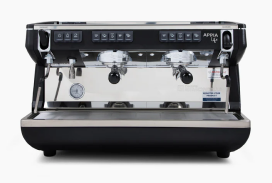
The Nuova Simonelli Appia Life Compact is a true commercial machine with volumetric dosing, a 5L steam boiler on the 1-group model, and NSF certification. Programmable shot volumes speed up workflow during rushes by removing guesswork from extraction. The optional autosteam wand finishes milk hands-free, which matters on a single-barista cart where every second counts.
Nuova Simonelli's pre-infusion chamber soaks the puck at lower pressure before full extraction begins. This reduces channeling, which is especially useful when speed affects tamping consistency. The Soft Infusion System adds further forgiveness to puck prep, a feature that pays off when service gets hectic.
Where it fits a cart build. The Appia Life Compact suits full-time cart operators running 60 to 120 drinks per service with a milk-forward menu. Volumetric controls and optional autosteam reduce barista cognitive load during busy windows. The 5L steam boiler recovers fast enough for steady back-to-back steaming without performance dips.
Where to plan around. At 15 inches wide and 92.6 lbs, the Appia Life Compact takes more counter and more muscle to load and unload than a prosumer machine. Autosteam and cool-touch wand upgrades add to the base price. Budget for both if you're building a one-person cart.
Pricing: $5,200

The Rocket Boxer Timer EVO carries the largest steam boiler in this tier at 8.3L. That copper boiler recovers quickly under sustained steaming and holds pressure through long runs of consecutive milk drinks. The Boxer Timer platform is Rocket's flagship commercial line, and the 1-group version brings that capability to a cart-sized format.
Volumetric dosing with a shot timer lets operators program repeatable pours. Cool-touch steam wands reduce burn risk during high-output service blocks. The stainless steel button interface and display are readable at a glance, even in bright outdoor light.
Where it fits a cart build. Operators running 80 to 150 drinks per service with a heavy milk menu will feel the benefit of that 8.3L boiler. It's the pick for cart owners who plan to grow into a trailer or semi-permanent setup and want a machine that won't need upgrading when volume increases.
Where to plan around. Power draw ranges from 2,000 to 2,400W, so generator capacity and circuit ratings need verification. At 102 lbs and 18.9 inches deep, it's a two-person load-in. Confirm your cart dimensions before ordering.
Pricing: $5,699
These machines carry higher price tags, but they bring dual-boiler or multi-boiler precision, pressure profiling, or build quality designed for years of daily commercial output.

The Faema Faemina sits between home and commercial classifications. It's a design-forward dual-boiler machine with Faema's GTI independent heating system, which manages brew and steam temperatures separately for stable extraction. The Be Faema app adds remote diagnostics and monitoring.
The Faemina also handles more than espresso. It can produce filter coffee, tea, and infusions from the same unit, making it unusual in this category. Voice recognition compatibility and an energy-saving auto-standby mode round out a tech-heavy feature set.
Where it fits a cart build. Presentation-driven carts at curated events, weddings, or brand activations benefit from the Faemina's aesthetic and multi-beverage range. If your cart menu extends beyond espresso into tea or specialty drinks, this machine covers that without additional equipment.
Where to plan around. Voltage configuration varies by model, so confirm the spec matches your power source. The app-dependent features require initial setup time, and service pricing sits above typical commercial machines. This pick rewards operators who value design and menu breadth over raw output volume.
Pricing: $5,500

The Rocket Bicocca is Rocket's dual-boiler 1-group with touch-sensitive controls on the group head's upper face and a 3.5-inch touchscreen. Independent brew (500 ml) and steam (1.5L) boilers keep temperatures stable during simultaneous use. The rotary pump runs significantly quieter than vibration-pump alternatives, a real advantage at low-noise venues.
Volumetric programming speeds up service during busy windows, and the NSF certification confirms commercial-grade build standards. The hot water spout handles americanos and tea orders without redirecting steam.
Where it fits a cart build. The Bicocca suits premium carts, corporate events, and venues where noise matters. Operators who want precise dual-boiler temperature control in a 1-group format will appreciate the independent brewing and steaming circuits.
Where to plan around. The 1.5L steam boiler is smaller than what you'd find on a commercial heat exchanger like the Boxer Timer EVO (8.3L) or Appia Life Compact (5L). For menus that lean heavily on milk drinks with sustained back-to-back orders, the smaller steam capacity means slower recovery at peak demand. At 77.16 lbs and 16.1 inches deep, it's more manageable to load than heavier commercial picks.
Pricing: $5,790

The Wega Polaris Compact brings Italian commercial pedigree and a 5L steam boiler to a 1-group format. Wega machines are a common sight in busy cafés, and the Polaris Compact translates that reliability to mobile service. E61 thermosyphon-stabilized groups, volumetric dosing with four programmable buttons, and auto-flushing groups (which discharge water automatically when the portafilter is removed) keep the workflow clean.
LED workspace lighting is a practical detail for evening events. A hot water dispenser covers tea and americano orders alongside the espresso menu.
Where it fits a cart build. Mid-to-high volume carts running events multiple days per week. Operators who want a proven Italian commercial platform with strong steam recovery and minimal maintenance steps during service.
Where to plan around. At 149.9 lbs, this is the heaviest machine on the list. Setup and teardown logistics need serious planning, including ramps, helpers, and a cart frame rated for the weight. The 21.26-inch height requires canopy clearance verification. Amp draw runs at 21A, so confirm your circuit and generator capacity.
Pricing: $6,476

The Sanremo YOU brings pressure profiling and multi-boiler precision into a 1-group cart format. Six standard extraction profiles and twelve fully customizable profiles let operators dial in everything from light single-origin shots to milk-heavy blend recipes. The touchscreen handles like a phone, which lowers the learning curve for new baristas.
Cold-touch steam and water wands reduce burn risk during fast service. USB profile loading means you can save and transfer recipes between events or machines. Eco modes (automatic and manual stand-by) reduce running costs during idle stretches.
Where it fits a cart build. Specialty coffee carts that market extraction quality and single-origin rotating menus. Operators competing at a premium tier who want profile control as a menu differentiator. Event-heavy carts where recipe consistency across different baristas matters.
Where to plan around. At $7,950, this is the highest investment on the list. Lead times may apply depending on configuration. Operators who want simple one-button service may find the feature depth unnecessary for their workflow.
Pricing: $7,950
Renewed machines lower the cost of getting quality equipment onto your cart. The savings are real when the machine comes from a vendor that runs full inspection, descaling, performance testing, and preventative parts replacement before sale.
Open-box and demo units, in particular, often carry near-new condition at meaningfully lower prices. Stock turns quickly on popular models, so checking availability before finalizing your cart budget is worth the effort.
The Rocket Appartamento Black & White Demo was used for less than two months and fully tested before listing. At $1,575 against a $2,100 standard reference price, the savings make this one of the strongest entry-tier cart picks available. Same 1.8L heat exchanger, E61 group head, and 10.7-inch width. Comes with a 12-month parts warranty and free shipping.
Minor cosmetic marks may be present, but mechanical performance is verified. For first-cart builds on a budget, this is a practical way to get Rocket quality at a lower entry point.
Pricing: $1,575 (sale) listed against $2,100 reference
The Appartamento Steel & Copper New Open Box is inspected, tested, and carries minimal handling marks. At $1,845 against the $2,100 reference, it's the closest option to a brand-new Appartamento at a reduced price. Same platform, same 12-month parts warranty, same free shipping.
For operators who want near-new condition without the full retail price, this slot fills that gap cleanly.
Pricing: $1,845 (sale) listed against $2,100 reference
The Sanremo Cube R Azure Lake Open Box drops premium Sanremo engineering into the value tier. The 1.9L stainless steel heat exchanger boiler pairs with an E61 thermosiphon group head and a rotary pump for quiet, consistent pressure delivery. At 12.7 inches wide, it fits tight cart counters easily.
Mechanical pre-infusion improves extraction consistency, and NSF certification confirms commercial-grade standards. At $2,399 against a $2,999 reference, the savings open up a Sanremo build for smaller-budget cart operators. Stock is limited to Azure Lake at this price.
Pricing: $2,399 (sale) listed against $2,999 reference
Run through these cart-specific checks before committing. They separate machines that work for your coffee cart espresso setup from machines that look great on paper but cause problems in service.

Confirm your venue outlet or generator delivers stable power at the wattage your machine draws, plus headroom for your espresso grinder and any refrigeration. Most cart-suitable machines fall between 1,100W and 2,400W. Generator capacity should exceed the total connected load by at least 20% for safe continuous operation. Match the machine's plug type and amperage to your setup before ordering, not after.
A 1-group machine ranges from roughly 10.7 inches wide (Appartamento) to over 18 inches (Boxer Timer EVO). Measure your usable counter area and allow room for a knockbox, milk pitchers, and staging. Depth matters as much as width on most carts. Weight affects loading logistics. Anything above 90 lbs typically requires two people and a ramp or platform.
Steam boiler capacity determines how many milk drinks you can serve before recovery slows. A 1.8L boiler handles moderate milk demand. A 5L boiler supports steady mid-volume steaming. An 8.3L boiler (like the Boxer Timer EVO) copes with high-volume milk-forward menus without dropping pressure. Match your boiler size to your menu, not to the machine's price.
Cart operators move between tank-fed and plumbed setups depending on the venue. Choose a machine that supports the mode your cart runs now, and ideally both modes if you plan to grow. Regardless of water source, water filtration protects the boiler from scale damage and is typically required to maintain warranty coverage. For tank-fed carts, fill from filtered sources and avoid mineral-heavy event water hookups.
A cart owner without a local technician depends entirely on vendor support. Warranty length, parts availability, and the quality of remote technical guidance matter more for mobile operators than for fixed-location cafés. Confirm these details before purchase.
Both new and renewed machines have a place in a cart equipment plan. The trade-off comes down to upfront budget, condition preference, and service timeline.
New machines suit operators planning a 5-plus-year cart run who want the longest service life from day one, need a specific configuration not available in renewed stock, or prefer factory-fresh condition and packaging.
Renewed machines suit budget-conscious first-cart builds, operators, adding a backup unit, or buyers comfortable with minor cosmetic marks in exchange for meaningful price savings. A properly renewed unit goes through deep cleaning, internal descaling, performance repair, preventative parts replacement based on component lifespan, exterior refinement, and full performance validation, including thermal stability and pressure tests.
Both paths work when matched to the right context. New gives you the widest configuration choice and the longest projected service window. Renewed gives you commercial-grade capability at a lower entry cost, which can free up budget for a better grinder or proper water filtration from the start.
Three setup variables determine whether your equipment runs reliably beyond the machine itself.
Confirm your venue or generator delivers stable power at the wattage your machine draws, plus headroom for a grinder and refrigeration. Most cart-suitable machines draw between 1,100W and 2,400W. Generator capacity should exceed your total connected load by at least 20% for safe continuous operation. Unstable power causes temperature fluctuations, tripped breakers, and mid-service shutdowns.
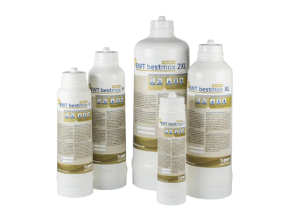
Every espresso machine manufacturer publishes target ranges for chloride, hardness, alkalinity, and pH. Water that falls outside those ranges causes scale buildup, boiler damage, and voided warranties. A basic inline filter protects the boiler and extends service life. For carts running tank-fed setups, fill from filtered water sources before each event. Skipping this step is the single most common reason cart machines need early boiler service.
If you plumb into a direct water source, pressure above the manufacturer's spec can damage internal components. A pressure regulator solves this at low cost and is often required for warranty validity. Even tank-fed machines benefit from consistent pump-fed delivery pressure.
Getting these three variables right keeps your machine performing consistently across hundreds of event days. A two-minute pre-event check (filter status, pressure read, generator load confirmation) prevents most mid-service problems.
Picking an espresso machine for a coffee cart starts with matching the machine to your real volume, power source, and counter layout. A prosumer heat exchanger handles low-volume pop-ups well. Commercial 1-group machines with larger steam boilers earn their place when milk drinks run steady and event days stack up. Dual-boiler and multi-boiler builds suit operators who want precision, profile control, or premium positioning over the long run.
Verify your power, measure your counter, define your peak drink count, and shortlist from there. The choice between new and renewed comes down to budget and condition preference. Both paths deliver reliable mobile espresso service when the machine is properly matched to the workload.
Pro Coffee Gear carries the full lineup of cart-ready models featured here, with free shipping, financing options, and the same 1-year parts warranty across new and renewed equipment. Renewed and open-box inventory moves fast on popular configurations, so the unit that fits your cart specs today may not sit in stock long.
For most small carts under 60 drinks per service, the Rocket Appartamento offers strong espresso performance in the smallest body at the lowest new price. Renewed Appartamento units extend that value further when available.
A 1-group machine handles most cart workloads up to roughly 100 drinks per service. Once peak volume consistently exceeds that or your menu requires sustained back-to-back milk drinks, a 2-group format may be worth evaluating.
New cart-ready machines in this guide range from $2,150 for a prosumer heat exchanger to $7,950 for a multi-boiler specialty build. Renewed open-box units start around $1,575 with the same 1-year parts warranty as new equipment.
Most cart-suitable machines draw between 1,100W and 2,400W on single-phase power. Your generator's continuous wattage must exceed the total load of all running equipment with roughly 20% buffer for stable operation.
Renewed machines perform reliably for mobile service when they've been fully inspected, descaled, tested, and backed by a parts warranty. The key is sourcing from a vendor with a documented renewal process, not a marketplace or auction listing.
A commercial espresso grinder with programmable dosing matches most cart workflows. Match the grinder's output capacity to your machine's group count and daily volume. Grinder wattage also factors into your total power budget, so include it in your generator or circuit calculations.
Our team can help you find the best fit based on your space, volume, and budget.
Talk to a Specialist

