


PID Controlled Espresso Machines: Key Features & Reviews
|
|
Time to read 11 min
Your Cart
Your cart
Favorites





Shop by Brands

Shop by Brands
Shop by Brands


Shop by Brands


Shop by Brands
Shop by Brands
|
|
Time to read 11 min
If you’ve ever pulled a shot that tasted mind-blowingly good one day and shockingly terrible the next, you already know the most common cause: temperature drift. Even small temperature swings can noticeably change flavor and shot time, turning a balanced espresso into something bitter, sour, or flat.
That’s exactly why PID-controlled espresso machines exist: precision-obsessed equipment built to keep temperature rock-solid, shot after shot.
In this PID-controlled espresso machine review, we show how these machines eliminate the temperature swings that ruin consistency.
Temperature stability is the secret weapon behind consistently great espresso; even small swings can noticeably affect flavor and shot time.
A PID-controlled espresso machine keeps heat locked in and stable, unlike basic thermostat machines that constantly fluctuate.
Key features that matter include adjustable temperature control, separate brew/steam PID management, boiler configuration suited to your workflow, and real-world thermal stability.
We explored real examples in our PID-controlled espresso machine review, comparing how different machines perform in actual everyday use, from home setups to small café environments.
A PID-controlled espresso machine adds an electronic temperature controller that continuously monitors and adjusts heat while you pull a shot.
PID stands for Proportional-Integral-Derivative, which sounds like something from a physics lecture, but here’s the only part you actually need to care about: It stops your machine from constantly swinging up and down in temperature like a roller coaster.
Quick technical explanation:
P (Proportional): Detects temperature changes and adjusts heat immediately.
I (Integral): Studies past temperature patterns and corrects long-term drift.
D (Derivative): Predicts future movement and stops overshooting before it happens.
Result: Rock-solid temperature control and way more consistent espresso.
Most regular espresso machines use a simple thermostat: heat up, cool down, repeat. A PID, on the other hand, is the calm, laser-focused driver. Micro-adjusting heat in real time. Just stable, precise temperature control that lets the coffee do what it’s supposed to do.
So why does temperature stability matter so much? Here’s the quick version:
Consistency drives flavor. Even small temperature shifts can change sweetness, acidity, and overall balance.
Repeatability. If your machine doesn’t hold temperature, you can’t dial in, every shot becomes a gamble.
Better extraction. Steady heat ensures water dissolves the right compounds at the right time for balanced flavor.
Less wasted coffee. No more throwing out shots that tasted great yesterday but terrible today.
Confidence. You get predictable results instead of relying on guesswork.
Most standard espresso machines rely on a basic thermostat. It works like this: heat up, turn off, cool down, repeat. That constant on-off cycle creates temperature swings, even if you can’t see them.
A PID works differently. Instead of reacting late, it micro-adjusts heat in real time, keeping temperature steady throughout the shot. Think of it as the difference between flooring the gas and slamming the brakes versus cruise control on a straight highway.
This difference matters more than most people realize.
|
Feature |
Thermostat-Controlled Machine |
PID-Controlled Machine |
|
Temperature control |
On/off cycling causes noticeable temperature swings |
Continuously adjusts heat in real time |
|
Stability during extraction |
Temperature can rise or drop mid-shot |
Holds a steady temperature throughout the shot |
|
Shot consistency |
Each shot can taste different, even with the same settings |
Shots are repeatable once dialed in |
|
Flavor clarity |
Higher risk of bitterness or sourness from uneven extraction |
Cleaner, more balanced flavor extraction |
|
Ease of dialing in |
Requires constant adjustment and guesswork |
Predictable results with minor tweaks |
|
Coffee waste |
More sink shots due to unstable temperature |
Less wasted coffee once settings are set |
|
User experience |
Feels reactive and unpredictable |
Feels controlled and confidence-building |
|
Best for |
Casual use or milk drinks where precision matters less |
Espresso-focused users who value consistency |
Now that we know why temperature stability is everything, let’s talk about what you should actually look for in a PID espresso machine.
Saying a machine has a PID is kind of like saying a car has an engine; technically true, but it tells you nothing about how well it actually performs. Some machines give you real control and precision.

Others just toss the word “PID” into the specs like a buzzword and call it a day. And if you don’t know the difference, it’s easy to end up paying for features that don’t actually move the needle for your espresso.
That’s why we always look at the details that separate a genuinely capable PID machine from one that just claims to be one.
Let’s walk through the features that actually matter:
If you can’t adjust it, you can’t control it. On a good PID machine, you should be able to:
Set your brew temperature in small steps (usually 1°F / 1°C).
See the actual temperature on a clear display.
Make small changes when you switch coffee beans (e.g., going darker or lighter roast).
On more advanced machines, you don’t just have one PID; you may have:
One PID controlling the brew boiler
Another PID controlling the steam boiler
Why this matters:
Brew water needs precision (for flavor and consistency).
Steam needs power and recovery (for milk drinks), but doesn’t need to be as precise.
PID doesn’t live in a vacuum; it works with the machine’s boiler design.
Common setups:
Single boiler + PID
Great for home users who don’t mind brewing and steaming separately.
PID helps keep brew temp stable, but you still need to wait between brewing and steaming.
Heat exchanger (HX) + PID
PID usually stabilizes the boiler temperature that feeds an HX system.
Good for people who want to brew and steam at the same time, but need to learn flushing routines.
Dual boiler + PID(s)
One boiler for brewing, one for steaming, often each with its own PID.
Ideal for those who prioritize consistency, speed, and heavy use.
Learn more about Sanremo Cafe Racer: Overview of Volumetric Multi-Boiler Espresso Machine
A PID is only as useful as the interface you actually touch every day.
Things that matter:
Readable display: You should be able to see the temperature at a glance.
Simple navigation: Changing temps or settings shouldn’t feel like hacking a 90s microwave.
Extras that help workflow: Some machines pair PID with a shot timer, pre-infusion settings, or profiles.
A PID controls the boiler, but temperature stability depends on more than software.
What to look for:
Group head design (E61, saturated, or integrated designs that retain heat)
Insulation quality around the boiler
Internal layout that minimizes heat loss between the boiler and puck
Key real-world questions:
Does the machine hold its set temperature throughout the shot?
How quickly does it recover between back-to-back shots?
Does steaming affect brew stability?
A strong implementation feels predictable. A weak one feels reactive.
This is where tech meets reality: your kitchen, your café, your habits.
Important points:
Boiler size: Larger boilers handle more back-to-back shots and steaming without losing stability.
Power requirements (15A vs 20A, 110V vs 220V): Especially relevant in the US; you want a machine that fits your available circuit.
Water source:
A reservoir-only system can be enough for a home.
Plumb-in options are better for higher-volume use and convenience.
Explore our guide to Important Features to Consider When Buying an Espresso Machine
Now that you know what to look for, let’s shift from theory to real-world models and dive into our PID-controlled espresso machine review.
We’re going to highlight a selection of real-world PID espresso machines, including ones ideal for home baristas and ones built for small cafés. We’ll focus less on pretty specs and more on how they behave when you’re actually pulling shots.
Let’s dig in.
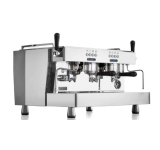
Best for: Small cafés, high-end home bars, and serious barista setups where consistency and workflow matter every hour.
Pros:
Each group head has its own dedicated brew boiler, isolated from the others for consistent temperature stability across groups.
Boiler temperatures are adjustable in 0.1°C increments via PID control, and each group includes an individual shot timer for precise workflow management.
Designed for high throughput: steam boiler capacity is 9 L (2-group variant) or 12 L (3-group), which supports frequent use without major recovery delays.
Built-in volumetric shot programming and individual shot timers add to workflow consistency, not strictly PID but complements the precision extraction.
Considerations:
High-end price and installation requirements: 220 V, 30 A for the 2-group version; 50 A for the 3-group.
It’s large and built for serious use, might be overkill for someone pulling one shot every morning at home.
Proper water filtration, service access, and professional installation are more critical than in a simpler machine, because with a high‐precision gear, small issues matter more.
This model is frequently discussed in specialty coffee communities, where owners often highlight its temperature stability and workflow advantages. For independent experiences and owner insights, consult barista forums and community discussions.
Best for: Serious home baristas or boutique café setups where shot-profiling, flavor nuance, and advanced control are key.
Pros:
Individual brew boilers for each group (multi-boiler setup) means outstanding temperature stability shot after shot.
Programmable PID temperature adjustable in 0.1°C increments per group head, as specified by the manufacturer.
Specialized flow-control needle valve and shot-mirror design add precision and workflow advantages in extraction.
Considerations:
Premium price tag, this is top-tier gear.
Requires serious installation: 220-240 V, multi-boiler plumbing, proper water filtration.
Maybe more machine than required if you’re just pulling one shot a day for yourself.
User Review:
reddit.com/r/espresso/comments/12fsziw/why_is_a_slayer_special/
On that thread, users comment on the machine’s flow-control and temperature stability, unlocking flavor nuances that lesser machines couldn’t handle.
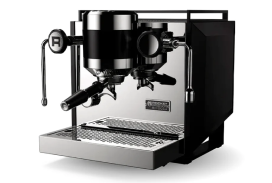
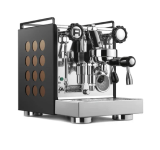
Best for: Home-baristas or prosumers who demand serious temperature control and workflow without stepping into full café territory.
Pros:
Features a heat-exchanger boiler with a dedicated PID controller for optimized temperature stability.
Adjustable brew temperature display lets you fine-tune settings for different beans or roast levels.
Compact size (~335 W × 420 D × 400 H mm) and reservoir-based water feed make it easier to integrate into a high-end home setup.
Considerations:
It’s still premium equipment: while easier than full café machines, you’ll want good water filtration and care with maintenance.
Being a heat-exchanger (not dual-boiler) means steaming and brewing at the exact same temperature may require technique and awareness.
Make sure your space supports its dimensions and power needs, given the boiler size and build.
User Review Snapshot:
reddit.com/r/espresso/comments/1arzdvc/thoughts_on_rocket_espresso_giotto_timer_type_v/
On that thread, users note how the PID control and stable boiler “feel like a real step up” for flavor consistency and shot repeatability, even in a home context.
Note: On HX machines, the PID primarily stabilizes boiler temperature; group temperature still depends on workflow and flush technique.
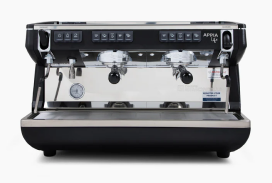
Best for: Those who want café-grade precision at home, or a serious small-café machine that doesn’t compromise.
Pros:
Dual boilers (brew + steam) with full PID temperature control, both brew and steam temps are actively managed.
Saturated group design ensures the group head itself is thermally stable and in sync with the brew boiler.
Programmable pressure profiling (via five profiles or full manual control) gives advanced users serious shot-crafting ability.
Designed to “bring commercial-grade performance into your home or small café,” per the product listing.
Considerations:
This is premium gear, requires commitment: space, water filtration, power & installation.
Because of the advanced capabilities (dual boiler + PID + profiling), there’s more setup and calibration compared to “plug & play” machines.
If you're only pulling one shot a day and steam rarely, some of this capability may go unused.
User Review Snapshot:
reddit.com/r/espresso/comments/15t2izq/rocket_r_nine_one_owners_how_do_you_like_it/
On that thread, owners praise how the machine’s PID and dual boiler keep temps stable, especially when doing back-to-back shots or milk drinks.
Best for: Specialty coffee shops or serious prosumer setups that demand top-tier temperature control, fast workflow, and barista-friendly features.
Pros:
Each brew group has its own dedicated boiler, and each boiler is controlled by its own PID controller: this multi-boiler + PID setup delivers extremely stable brew temperatures.
Designed with a “low-profile” form factor to fit into tighter bar setups without sacrificing professional performance.
Programmable volumetric dosing, pre-infusion control, and advanced workflow options make this machine highly versatile for café-style use.
Considerations:
Installation requirements: This is commercial-grade gear, so proper plumbing, filtration, and power supply are essential.
While performance is top-tier, it may be more machine than needed if a home‐barista is only pulling one shot per day.
Maintenance and training matter: advanced features demand that the operator understand how to optimize them for the best results.
User Review Snapshot:
reddit.com/r/espresso/comments/1ax9ovf/any_experience_with_synesso/
In that thread, users highlight that the S-Series’ temperature stability and build quality stand out especially in higher workflow settings, making it a favorite for shops that run heavy volumes.
At the end of the day, great espresso isn’t magic; it’s control. And PID machines don’t just give you more buttons to play with; they give you the power to make every shot intentional, repeatable, and genuinely dialed-in.
Before you commit, confirm:
Adjustable brew temperature (in small increments)
Boiler type that matches your workflow (single, HX, dual, or multi-boiler)
Stable group design and insulation
Power compatibility with your space (110V vs 220V, amperage requirements)
Parts availability and service support
This PID-controlled espresso machine review shows how temperature stability directly impacts consistency, flavor clarity, and repeatability. When temperature stops drifting, everything else gets louder: sweetness, body, clarity, balance.
If you’re ready to build a setup that supports that level of control, explore our lineup of PID-equipped machines at Pro Coffee Gear. The tools are here; now it’s time to unlock what your coffee is actually capable of.
Yes. Milk can soften flaws but can’t fix them. Stable brew temperature keeps the espresso base balanced, which makes milk drinks taste noticeably better.
Often, yes. Inconsistency is usually caused by temperature drift. A PID keeps brew temperature steady, making shot flavor more repeatable.
Absolutely. PID control removes guesswork by holding temperature steady, making it easier to dial in consistent shots without constant adjustment.
Quality PID machines are built for longevity. With proper water filtration and routine care, they’re no harder to maintain than standard machines.
Yes. Temperature stability is foundational. Without it, upgrades elsewhere won’t deliver their full impact.
Our team can help you find the best fit based on your space, volume, and budget.
Talk to a Specialist

