


Espresso Scale Explained: Get Café-Quality Shots At Home
|
|
Time to read 8 min
Your Cart
Your cart
Favorites





Shop by Brands

Shop by Brands
Shop by Brands


Shop by Brands


Shop by Brands
Shop by Brands
|
|
Time to read 8 min
Do your homemade espresso shots taste unpredictably sour or bitter? Inconsistent flavor is a common frustration for many home baristas. The visual cue of volume is a deeply unreliable metric.
This problem almost always stems from inconsistent coffee and water measurements. Precision is the secret behind great espresso. Using an espresso scale provides the data you need for control. You can finally move from guessing to knowing what works.
Our guide will explain exactly how to use this essential tool. We cover key features that matter for your workflow. You will also learn the step-by-step process for perfect shots.
An espresso scale measures coffee and beverage weight with precise data.
The key benefit is shot consistency, allowing you to replicate perfect results.
Essential features include 0.1-gram resolution, fast response time, and a built-in timer.
A built-in auto-tare function is helpful but optional for workflow speed.
Your brew ratio (coffee in to espresso out) is the fundamental recipe for balanced flavor.
The scale provides real-time feedback on extraction quality and puck preparation.
Proper maintenance involves regular cleaning and periodic accuracy checks.
An espresso scale is a highly precise digital scale for coffee brewing. It measures weight in increments of 0.1 grams for total accuracy. This tool fits perfectly under your portafilter or drip brewer. Its primary function is to measure coffee dose and liquid espresso yield.
This device matters because it replaces visual guesswork with hard data. You can precisely track your coffee input and beverage output for every shot. This data allows you to calculate your brew ratio with confidence. Using a scale gives you exact control over dose and yield.
The scale must also be heat-resistant to withstand your machine's drip tray. You will no longer wonder why one shot was perfect and the next was not. An espresso scale provides the feedback needed for meaningful improvement.
Also read: Understanding PID Temperature Control in Espresso Machines
Now that we've defined its core purpose, let's explore the specific advantages it brings to your routine.
Moving beyond a simple definition, the scale's value lies in actionable control. It transforms your process from instinctual repetition to data-driven refinement. This tool provides the objective feedback necessary for genuine skill development.
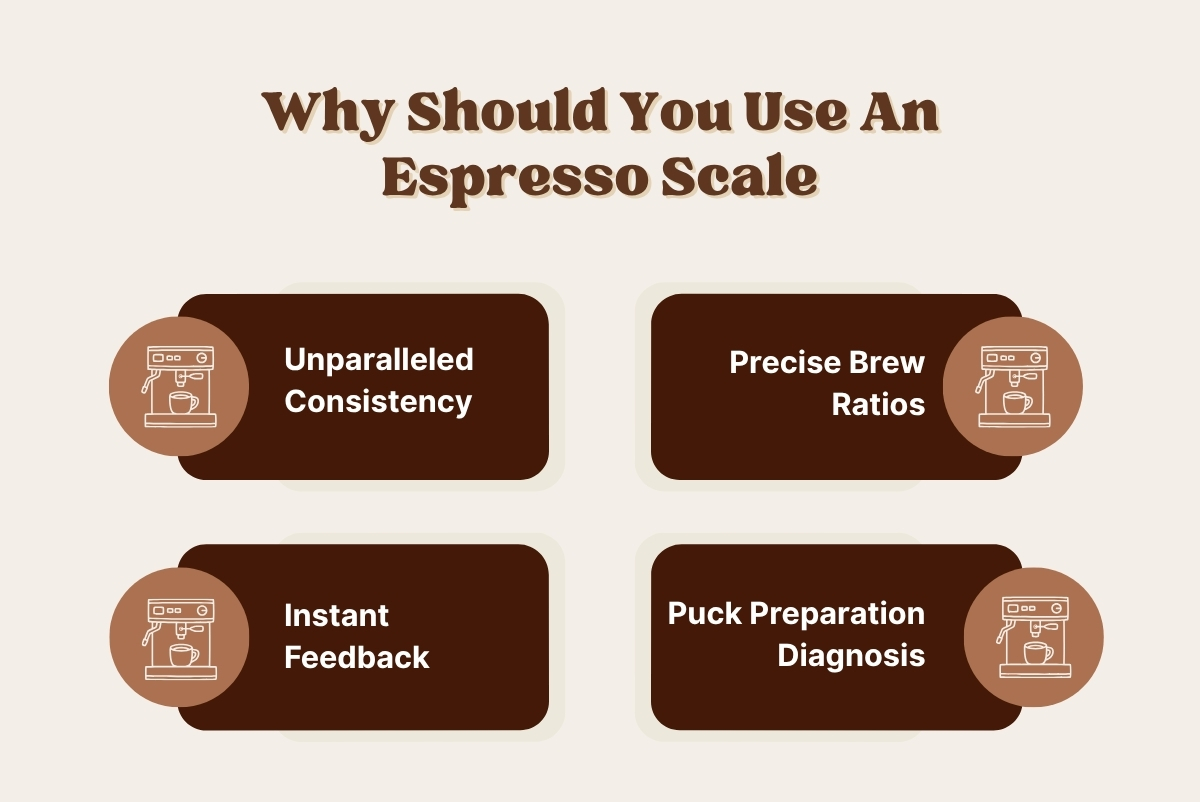
You stop making random adjustments and start executing informed recipes. The benefits extend far beyond just weighing coffee grounds. A scale impacts every variable in your extraction workflow.
Here are the core reasons a scale will revolutionize your coffee:
You can replicate a perfect shot using the exact same measurements. This eliminates the daily guesswork that leads to flavor variations.
Your brew ratio is the primary recipe for balancing espresso strength. You can easily experiment with different ratios for new flavor profiles.
Track shot duration and observe flow rate in real-time. This helps you identify shots that are pulling too fast or too slow.
An uneven puck causes channeling during extraction. Your scale shows a rapid, jumpy weight increase that highlights this issue.
Also read: Espresso Portafilter Sizes: Choose the Right One for Consistent Extraction
To access these benefits, you need a scale built for the task. Here’s what separates a dedicated espresso tool from a basic kitchen scale.
Not all kitchen scales are suitable for the espresso brewing environment. You need a tool designed specifically for this precise and sometimes messy task. The right feature set separates a professional tool from a basic scale.
Here are the essential features that define a quality espresso scale:
Look for a scale that measures in 0.1 gram increments. A 1–2 kg capacity is enough for cups and portafilters.
The scale must update its display quickly as espresso drips. This allows for real-time flow rate assessment.
Pairing your scale with a stable machine maximizes consistency. This investment directly supports your journey toward excellent espresso. Pro Coffee Gear machines are built for the stability that precision brewing demands. Explore our range now.
An integrated timer measures shot duration simultaneously with weight. This combines two critical data points on one display.
This feature instantly resets the display to zero with any vessel. It streamlines your workflow during busy brewing sessions.
A sealed body protects against occasional spills and moisture. A silicone pad helps insulate against heat from the drip tray.
This feature instantly resets the display to zero with any vessel. It streamlines your workflow during busy brewing sessions.
Also read: Best Espresso Tamper for Perfect Coffee
With the right scale selected, the next step is integrating it into a repeatable and effective brewing process.
Understanding your scale's features is just the first step. Now we apply that knowledge to a practical, repeatable brewing routine. You will move from hoping for a good shot to knowing how to achieve it.

Follow these steps to create the perfect shot:
Place your scale securely on the machine's drip tray. Position your empty portafilter on the scale's center. Press the tare button to reset the weight display to zero. This ensures you measure only the coffee grounds, not the portafilter.
Grind your coffee beans directly into the portafilter on the scale. Watch the display until you reach your target dose weight. A typical starting dose is 18 grams of coffee. This precision is the foundation of your entire espresso recipe.
After distributing and tamping your grounds, place your cup on the scale. Tare the scale once more to zero it with the cup in place. Start extraction; the scale’s timer will activate or start it manually. This begins tracking your extraction metrics.
Watch the scale's display as espresso flows into your cup. Stop the extraction when you reach your target beverage yield. A common starting yield is 36 grams for an 18-gram dose. Note the final time and weight to evaluate and replicate the shot.
Note: The weight may jump initially during pre-infusion.
Following a structured method eliminates variables and builds your expertise. Each step provides specific feedback you can use for refinement. Consistency in your process leads directly to consistency in your espresso.
Also read: Understanding Espresso Shot Measurements: Grams and Ounces
Protecting your investment is crucial for maintaining this new level of precision over the long term.
Proper care protects your scale's precision and extends its functional life. Espresso environments expose scales to moisture, heat, and coffee grounds. A consistent maintenance routine prevents damage and ensures accurate readings.
Follow these essential practices to preserve your scale's accuracy:
Wipe the platform with a damp, soft cloth immediately after brewing. Avoid harsh chemicals to prevent sensor damage.
Avoid dropping the scale or placing heavy objects on it. Store in a dry location away from heat sources. Remove batteries only for long-term storage exceeding two months.
Use a known weight, like a 100-gram standard, to verify readings periodically. Always calibrate on a level surface. Consult the manual for recalibration if readings are incorrect.
Replace batteries at the first sign of a low power warning. Weak batteries cause inaccurate readings and display lag.
Neglecting these practices can lead to drift and measurement errors. Simple habits will keep your tool performing like new for years. This reliability is crucial for maintaining your coffee quality. Here’s how to solve the most common problems.
Even with excellent maintenance, you may encounter occasional technical problems. Understanding these common issues will save you time and frustration. Most scale malfunctions have simple, user-serviceable solutions you can try first.
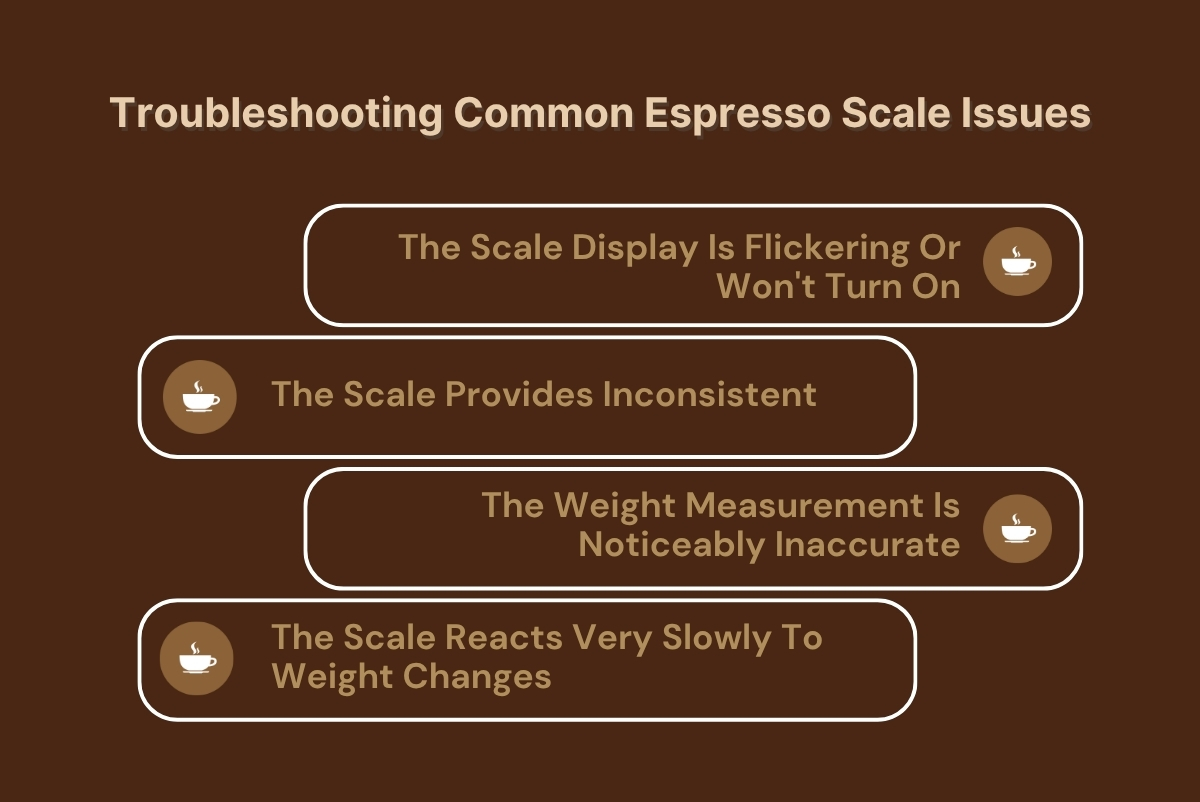
This knowledge helps you quickly restore your workflow's precision. Here are solutions for the most frequent espresso scale problems:
Replace the batteries with a fresh, high-quality set. Ensure the battery terminals are clean. This resolves most power-related issues.
Place the scale on a stable, level surface. Check for debris under the platform. Avoid vibrations from grinders or appliances.
Test with a known calibration weight. Confirm proper tare procedure and avoid overloading capacity. Consult the manual for recalibration if needed.
Replace batteries even without a low-power warning. If stored in cold conditions, warm to room temperature before use.
Clean the scale's feet and weighing surface. Keep away from drafts and vibrations.
Also read: Important Features to Consider When Buying an Espresso Machine
An espresso scale provides the data for a more consistent extraction. It tracks your coffee dose and beverage yield with clear numbers. This approach brings clarity and control to your brewing process. An espresso scale gives you the consistency you can taste.
This method works best with reliable and consistent equipment. Pro Coffee Gear provides espresso machines known for their steady performance. Our selection supports the precise workflow you aim to build.
View our lineup of espresso machines to find your ideal match.
An espresso scale offers 0.1-gram resolution, fast response time, and often a built-in timer. These features are essential for tracking a shot in real time. Most kitchen scales lack this necessary speed and precision.
Crema makes judging volume inconsistent between shots. Weight provides an objective, reliable metric for your recipe. This leads to far greater consistency in your final cup.
A 1:2 brew ratio is an excellent starting point. This means 18 grams of coffee to 36 grams of espresso. This ratio typically produces a well-balanced and flavorful shot.
Check your scale's manual for an "auto-off" disable function. Some espresso scales offer an auto-off override or brewing mode. Ensuring fresh batteries also helps prevent premature shut-off.
Yes, but only if the scale is specifically designed to be spill-resistant. Check the manufacturer's specifications for water resistance before exposing it to moisture.
Yes, a precision scale is equally valuable for pour-over brewing. It helps you measure coffee and water accurately while timing bloom and pour phases.
Our team can help you find the best fit based on your space, volume, and budget.
Talk to a Specialist

