


Volumetric vs Semi-Automatic Espresso Machines: Which Fits Your Café?
|
|
Time to read 11 min
Your Cart
Your cart
Favorites





Shop by Brands

Shop by Brands
Shop by Brands


Shop by Brands


Shop by Brands
Shop by Brands
|
|
Time to read 11 min
Choosing between a volumetric vs semi-automatic espresso machine comes down to how much control your team needs during service. A volumetric espresso machine automatically stops the shot at a programmed water volume. A semi-automatic espresso machine requires the barista to manually start and stop each extraction.
For cafés, carts, restaurants, and office coffee setups, that difference affects workflow, consistency, and staff training. Volumetric machines can help teams repeat recipes more easily during busy shifts. Semi-automatic machines give trained baristas more hands-on control over timing and shot volume.
The better choice depends on your service style, staff skill level, drink volume, and equipment setup. In this guide, we’ll compare both machine types, show where each one fits best, and highlight options that match different commercial workflows.
The main difference is how each machine controls the end of the shot. That one workflow detail can affect consistency, staff training, and how smoothly your bar runs during busy service.
|
Factor |
Volumetric espresso machine |
Semi-automatic espresso machine |
|---|---|---|
|
Shot control |
Stops at a programmed water volume |
The barista manually starts and stops the shot |
|
Best fit |
Cafés, restaurants, carts, and offices that need repeatable recipes |
Barista-led cafés and teams that want more hands-on control |
|
Staff training |
Easier to standardize once recipes are programmed |
Requires more skill and attention during extraction |
|
Workflow speed |
Helps reduce shot-timing variation during rushes |
Gives the barista more control, but needs closer monitoring |
|
Consistency |
Strong fit for multi-staff environments |
Depends more on the barista's technique and timing |
|
Main trade-off |
Less manual control over each shot |
More room for variation between staff members |
For most commercial buyers, volumetric machines are the better fit when repeatability matters across shifts. Semi-automatic machines make more sense when trained baristas want direct control over each extraction.
Decision Matrix:
|
If You Need… |
Choose |
|---|---|
|
Consistency across multiple staff |
Volumetric |
|
Maximum barista control |
Semi-automatic |
|
Faster staff onboarding |
Volumetric |
|
Barista-led coffee program |
Semi-automatic |
A volumetric espresso machine is built for repeatable shot delivery. Instead of asking the barista to stop every shot manually, the machine ends the extraction when it reaches a programmed water volume.
This does not mean the machine does everything for you. Your team still needs to set the grind, dose, tamp, yield, and extraction target correctly. Water quality, cleaning, and grinder consistency still matter.
Because coffee absorbs water differently depending on roast and grind settings, volumetric dosing controls water volume rather than final beverage weight.
Here is the practical trade-off for commercial service:
|
Pros |
Cons |
|---|---|
|
Helps standardize recipes across different staff members |
Gives the barista less direct control over every shot |
|
Reduces manual shot timing during rush periods |
Still needs proper dialing in, cleaning, and grinder setup |
|
Supports a smoother workflow when staff move between tasks |
Programmed settings may need adjustment as coffee changes |
|
Works well for cafés, carts, restaurants, and offices with rotating staff |
May be more automation than a small barista-led setup requires |
A semi-automatic espresso machine gives the barista direct control over each shot. The machine provides pump pressure, but the barista decides when to start and stop extraction.
That control can be useful for experienced teams. A trained barista can adjust shot timing based on the coffee, grind setting, dose, and target yield.
Here is the practical trade-off for commercial service:
|
Pros |
Cons |
|---|---|
|
Gives trained baristas more control over shot timing |
Requires more attention during busy service |
|
Supports hands-on espresso programs and training bars |
Can create more variation between staff members |
|
Works well when recipes change often |
Needs stronger barista skills and consistency |
|
Keeps the workflow simple without programmed dosing |
May experience slow service if staff need to monitor every shot closely |
For the right team, semi-automatic control can support a precise espresso workflow. It works best when staff have the skill and time to manage each shot closely. After choosing a control style, check whether the machine fits your space, menu, and service volume.
If your team already knows which control style fits your bar, compare our current auto-volumetric and semi-automatic espresso machines by group count, footprint, and workflow fit.
Also Read: Best Semi-Automatic Espresso Machines in 2026: Features, Pros and Cons
The control style matters, but it should not be the only reason you choose a machine. A volumetric or semi-automatic machine still needs to match your space, service volume, and staff workflow.
Start with group count. A 1-group machine may fit a cart, small café, or office bar. A 2-group or 3-group machine usually makes more sense for busier cafés, restaurants, and multi-barista setups.
Next, compare the boiler type and steam power. If your menu includes a high volume of lattes, cappuccinos, and other milk drinks, steam performance can affect speed during rushes.
You should also check:
Footprint: Will the machine fit your counter and leave room for grinders, pitchers, and workflow?
Voltage and plumbing: Does your space support the machine’s power and water requirements?
Water filtration: Is your water setup protecting the machine and supporting consistent espresso?
Grinder pairing: Does your grinder match the machine’s output needs?
Parts and support: Can you get service, advice, and replacement parts when needed?
Warranty terms: What coverage applies to the specific machine and condition you choose?
Long-term ownership costs are an important part of your decision. Consider:
Training costs: Time and resources to bring staff up to speed on machine operation.
Labor consistency: How the machine type affects consistency across different baristas.
Workflow efficiency: Whether the machine supports smooth service during busy periods.
Maintenance considerations: Cleaning routines, replacement parts, and technical service availability.
Volumetric Machines:
Cafés with highly experimental espresso programs
Operators who frequently adjust recipes throughout the day
Semi-Automatic Machines:
Businesses with frequent staff turnover
High-volume operations prioritizing consistency over customization
A good espresso machine should fit the way your business serves coffee every day. Control style helps narrow the list, but the final choice should also support your layout, drink menu, and long-term ownership needs.
Also Read: Important Features to Consider When Buying an Espresso Machine
A machine that fits one service model may not fit another. A small barista-led counter, a high-volume café, and a restaurant espresso station all need different levels of control, speed, and staff flexibility.
With a volumetric machine, the barista can start the shot and move to the next task once the recipe is programmed. That can support a smoother handoff between grinding, brewing, steaming milk, and serving drinks.
With a semi-automatic machine, the barista stays more involved in each extraction. This can support a more hands-on espresso program, but it also means the workflow depends more on staff attention and timing.
The machine type matters, but it is not the only factor. Group count, boiler power, grinder pairing, and bar layout can affect workflow just as much as the dosing style. Once the workflow difference is clear, compare machines that match each control style.
Once you know the workflow difference, the next step is choosing a machine that fits your service volume, staff, and counter setup. These options show how volumetric and semi-automatic control can fit different commercial environments.

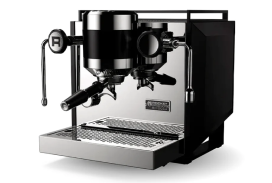
The Rocket Espresso BOXER TIMER EVO is a strong option for cafés that want programmable shot control with higher commercial output. Starting from $7,999 USD, it gives busy teams a more repeatable workflow while still offering commercial configuration choices.
This machine is a strong fit for smaller cafés and operations that need commercial performance without the footprint of larger multi-group machines.

The Rocket Espresso BOXER TIMER EVO 1 Group is a compact volumetric option for carts, catering setups, small cafés, and lower-volume bars. At $5,699 USD, it gives operators commercial espresso capability without requiring the footprint of a larger multi-group machine.
It is a practical fit when you want programmed shot control, but your business does not need the output of a full-size café machine.

The Wega IO EVD is a compact 2-group auto-volumetric espresso machine for smaller commercial spaces. At $6,796 USD, it gives cafés, restaurants, and pubs programmed shot control without taking up as much counter space as a larger commercial machine.
It uses a heat exchanger system, pre-infusion technology, and programmable volumetric dosing. This makes it a practical fit for businesses that want a compact footprint, steady service flow, and repeatable shot volumes across different staff members.

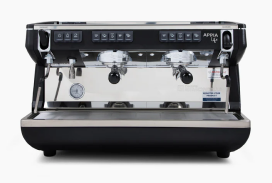
The Nuova Simonelli Appia Life Semi-Automatic is a strong fit for commercial teams that want manual shot control on a proven café platform. At $8,150 USD, it gives baristas direct control over when extraction starts and stops, which helps teams adjust each shot based on recipe, timing, and espresso style.
It uses a heat exchanger setup and includes Nuova Simonelli’s Soft Infusion System, making it a practical option for cafés that want hands-on control without moving into a more complex machine class.

The Nuova Simonelli Appia Life Compact Semi-Automatic is better suited to smaller bars, cafés, carts, and restaurants that want semi-automatic control in a more compact footprint. It starts from $4,600 USD and is available in 1-group and 2-group configurations.
This option makes sense when counter space matters, but the team still wants manual control over each shot. It also gives smaller businesses a way to keep a barista-led workflow without choosing a larger machine than the space or service volume needs.

The Nuova Simonelli Aurelia Wave Semi-Automatic is a better fit for medium to larger cafés that want more bar capacity with manual espresso delivery. It starts from $10,400 USD and is available in 2-group and 3-group options.
This machine works well for experienced teams that want semi-automatic control, but still need a serious commercial build for daily service. It includes manual dosing, Soft Infusion System, pre-infusion, cool-touch steam wands, raised group heads, and automated cleaning features. That makes it a stronger fit for cafés where baristas control the shot, but the business still needs workflow support during busy shifts.
The Rancilio Classe 7 S is another semi-automatic option for commercial cafés that want manual shot control from a different manufacturer. Starting from $10,400 USD for 2-group configurations, it gives operators a heat exchanger platform with semi-automatic dosing, steady brew performance, and strong steam capacity for busy café environments.
This machine makes sense for cafés that want a durable commercial build, simple push-button brew controls, and a more traditional semi-automatic workflow. It is a practical fit for teams that want barista control over extraction while still needing reliable output across daily service.
If you are narrowing options for a café, cart, or restaurant, explore our commercial espresso machines to compare group count, footprint, boiler type, and workflow fit.
Also Read: How Much Does a Commercial Espresso Machine Cost in 2026?
Both machine types can work well in commercial settings. The better choice depends on your workflow, staffing, and service model.
A volumetric machine is worth considering when your business needs consistent espresso across different shifts, staff members, and rush periods. It helps reduce one common variable: when the shot stops.
That can be useful in cafés, restaurants, hotels, carts, and office coffee bars where several people use the same machine. Once recipes are programmed, staff have a clearer workflow to follow during service.
Volumetric control is usually a stronger fit if your business has:
Multiple baristas on rotation
Newer staff who need a more standardized process
Busy counters where staff move between espresso, milk steaming, and customer service
High milk-drink volume during rush periods
A need for repeatable espresso across shifts
A semi-automatic machine can be the better choice when your team wants hands-on control over each espresso shot. The barista decides when extraction should stop based on timing, yield, and how the shot is running.
This can work well in cafés where espresso technique is part of the service style. It also suits teams that are comfortable dialing in throughout the day and adjusting recipes as coffee changes.
Semi-automatic control is usually a stronger fit if your business has:
Experienced baristas managing the machine
A barista-led espresso program
Training environments that teach shot timing and extraction control
Coffee programs that change recipes often
Smaller shops where one skilled barista handles the bar
Volumetric control is usually better for consistency across staff. Semi-automatic control is usually better for direct barista involvement. The right choice is the one that supports your team’s pace, skill level, and service model.
Choosing the right espresso machine comes down to your team, workflow, and service needs. For multi-staff commercial environments, volumetric machines provide greater consistency and smoother workflow. For experienced barista-led programs, semi-automatic machines offer more direct control over extraction and flexibility to fine-tune each shot. Consider your space, menu, staff skill, and long-term operational needs to make the best choice for your café, cart, or restaurant.
At Pro Coffee Gear, we keep a curated collection of commercial espresso machines for cafés, carts, restaurants, offices, and hospitality setups. You can compare volumetric and semi-automatic options by group count, footprint, boiler type, and workflow fit.
Need help narrowing down the right espresso machine for your café, cart, or restaurant? Explore our commercial espresso machines at Pro Coffee Gear or reach out to us for guidance based on your workflow.
Suggested Read: Espresso Machine for Coffee Cart in 2026: Compact and Commercial Picks
Not always. Many commercial automatic espresso machines use volumetric dosing, which means the machine stops the shot at a programmed water volume. Still, product names can vary by brand, so it is best to check the machine’s dosing type before buying.
Not by itself. A semi-automatic machine gives trained baristas more control over shot timing, but espresso quality still depends on the grinder, recipe, water quality, cleaning routine, and barista skill.
Not every café needs one. Volumetric machines are useful when multiple staff members use the same machine or when the business needs repeatable drinks during busy service. A smaller barista-led café may still do well with a semi-automatic machine.
A small café with newer staff, rotating shifts, or a busy morning rush may benefit from a volumetric machine. A small café with experienced baristas and a hands-on espresso program may prefer a semi-automatic machine. The better choice depends on staff skill, drink volume, and workflow.
Our team can help you find the best fit based on your space, volume, and budget.
Talk to a Specialist

