


How to Decide Whether to Choose Pressurized or Non-Pressurized Basket?
|
|
Time to read 9 min
Your Cart
Your cart
Favorites





Shop by Brands

Shop by Brands
Shop by Brands


Shop by Brands


Shop by Brands
Shop by Brands
|
|
Time to read 9 min
A bad shot is easy to blame on the beans, machine, or barista. Sometimes, the real issue is the basket inside your portafilter.
A pressurized basket helps build pressure when your grinder or technique is not fully dialed in. A non-pressurized basket gives you more control, but it also exposes every flaw in grind size, dose, distribution, and tamp.
That choice matters. The wrong basket can leave you chasing sour shots, fast flow, weak crema, or inconsistent results without realizing your setup is the problem.
For home users, the decision usually comes down to grinder quality and skill level. For cafés and serious bar setups, non-pressurized baskets are usually the standard because they give trained baristas better feedback and repeatability.
This guide breaks down how both baskets work, where each one makes sense, and how to choose the right option for your setup.
Pressurized baskets build pressure mechanically via a single exit hole; non-pressurized baskets rely entirely on puck resistance.
Pressurized baskets work at around 250–400 microns; non-pressurized baskets need somewhere around 150–250 micron grind to extract properly.
Crema from a pressurized basket is aerated foam, not true emulsified coffee oils from proper extraction.
When switching to a non-pressurized basket, move your grinder three to five steps finer immediately and re-dial from scratch.
Clean the pressurized basket exit hole regularly with a non-metal cleaning tool, as recommended by the manufacturer. Avoid toothpicks, which can break and leave debris behind.
The right basket depends on your grinder, your skill level, and what you're trying to get out of every shot.
You're working with a basic or entry-level grinder that doesn't grind fine or consistently enough for espresso.
You're new to pulling shots and still building your technique.
You want forgiving, low-maintenance extraction without constant dialing in.
You're using a beginner home machine, office setup, or low-control environment where simplicity matters more than full extraction control.
You're running a quality burr grinder capable of consistent, fine espresso grinds.
You want full control over extraction and are comfortable adjusting grind, dose, and tamp.
You're pulling shots for a commercial bar or a serious home setup where repeatability matters.
You're chasing clarity, texture, and nuance in the cup rather than just a quick result.
A quick note on crema: Pressurized baskets produce a thick, foamy crema that looks great in the cup. In our testing, that crema dissipates faster and carries less of the aromatic complexity you get from a properly extracted non-pressurized shot. It's a visual result more than a flavor one.
Also read: Espresso Portafilter Sizes: Choose the Right One for Consistent Extraction.
Grind size is where basket choice and workflow either come together or fall apart, and getting this right from the start saves a lot of wasted coffee and frustration. But there is no single grind setting that works for every setup.
Coffee origin, roast level, basket design, dose, grinder quality, and puck prep can all shift the ideal range.
Pressurized basket: A common starting point is around 250–400 microns, roughly the texture of table salt. The mechanical valve does the pressure-building work, so you have room to be a little less precise here. Pre-ground coffee in this range pulls a drinkable shot without much fuss.
Non-pressurized basket: A typical starting range is closer to 150–250 microns, closer to powdered sugar in texture. The puck itself has to generate all the resistance for a proper 9-bar extraction.
Grind size doesn't stop at espresso, and if you're running multiple brew methods across your operation, here's a quick reference to keep everyone on the same page.
Important note: Even small grinder adjustments can change the flow rate, shot time, body, and flavor. Treat the following numbers as calibration guides only. Then adjust based on how the shot runs and tastes.
|
Brew Method |
Grind Size Range |
Texture Reference |
Brew Time |
|---|---|---|---|
|
Non-Pressurized Espresso |
150–250 microns |
Powdered sugar |
25–30 seconds |
|
Pressurized Espresso |
250–400 microns |
Table salt |
25–35 seconds |
|
Moka Pot |
300–400 microns |
Fine table salt |
4–5 minutes |
|
AeroPress |
320–960 microns |
Medium-fine sand |
1–3 minutes |
|
Drip / Auto Filter |
500–900 microns |
Granulated sugar |
4–6 minutes |
|
Hario V60 |
500–650 microns |
Medium sand |
2:30–3:30 min |
|
Kalita Wave |
600–700 microns |
Medium sand |
3:00–3:45 min |
|
Chemex |
650–750 microns |
Coarse sand |
3:30–4:30 min |
|
French Press |
750–1,000 microns |
Ground black pepper |
4 minutes |
|
Cold Brew |
1,000–1,400 microns |
Coarse sea salt |
12–24 hours |
|
Turkish Coffee |
40–220 microns |
Flour |
3–4 minutes |
If you just picked up a new espresso machine and you're staring at two baskets wondering which one to load up first, this part is for you. Let's break down exactly how each one works.
Also read: Grinding Coffee Beans at Home: Techniques and Benefits
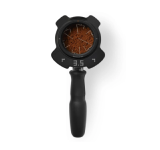
A pressurized basket has two floors stacked inside it. The inner floor has multiple holes, but the outer floor has just one small exit hole at the center.
Water collects between the two floors, pressure builds up, and then forces through that single hole regardless of how the coffee was ground.
Works with a wide range of grind sizes, including pre-ground supermarket coffee, so you don't need a precision grinder to pull a decent shot.
Forgiving of uneven tamps and minor dose inconsistencies, which makes it a solid choice for low-volume stations or less experienced staff.
Produces a visually thick crema that holds up well in milk-based drinks like lattes and cappuccinos.
Easy to maintain, with no complex puck prep required before each shot.
A useful learning tool for beginners at home, though commercial staff should usually train on non-pressurized baskets from the start.
The single exit hole accumulates coffee oils quickly and needs regular cleaning to prevent unpredictable shot behavior.
Offers very little feedback on what's actually happening inside the puck, making it harder to diagnose extraction problems.
Limits your ability to refine flavor clarity and texture as your setup or skill level improves.
A non-pressurized basket has a single floor punched with hundreds of tiny, evenly spaced holes across the entire surface.
There is no valve or secondary restriction. Water flows through the coffee puck itself, which means your grind, dose, and tamp together create all the resistance needed to build proper extraction pressure.
Gives you complete control over extraction, so every variable you adjust in grind or tamp shows up directly in the cup.
Produces truer espresso with more flavor clarity, better texture, and a denser, more aromatic crema.
Works seamlessly with a quality burr grinder to deliver consistent, repeatable results across a full service.
Makes channeling and uneven distribution immediately visible, especially with a bottomless portafilter, which helps baristas dial in faster.
Scales well for commercial output where shot-to-shot consistency is non-negotiable.
Demands a quality burr grinder capable of hitting the 150–250 micron range with consistency, which adds to your equipment cost.
Leaves no room for sloppy technique, so grind, dose, distribution, and tamp all need to be dialed in before every service.
Here is a side-by-side breakdown of both baskets across every variable that matters to your workflow and your cup.
|
Feature |
Pressurized |
Non-Pressurized |
|---|---|---|
|
Pressure mechanism |
Mechanical single-exit valve |
Coffee puck resistance |
|
Grind size required |
250–400 microns |
150–250 microns |
|
Grinder quality needed |
Entry-level burr or blade |
Quality burr grinder only |
|
Tamp sensitivity |
Low |
High |
|
Extraction control |
Limited |
Full |
|
Crema quality |
Thick but less complex |
Dense, aromatic, true crema |
|
Flavor clarity |
Moderate |
High |
|
Channeling visibility |
Not visible |
Visible, especially bottomless |
|
Maintenance |
Weekly exit hole cleaning |
Regular basket soaking |
|
Best for |
Beginners, low-volume stations |
Commercial bars, experienced baristas |
|
Pre-ground coffee compatible |
Yes |
No |
|
Skill ceiling |
Low |
High |
Your basket type sets the floor for what your grinder needs to deliver, so pairing them correctly from the start keeps your workflow tight and your shots consistent.
|
Basket Type |
Grinder Type Suited |
Best Grinder Picks from Pro Coffee Gear |
Price Range |
|---|---|---|---|
|
Pressurized |
Burr is always better, no need for stepless adjustment. |
$999-$1,667 |
|
|
Non-Pressurized |
Quality flat or conical burr grinder with stepless adjustment, consistent particle distribution in the 150–250 micron range is non-negotiable. |
Fiorenzato F64 EVO PRO SENSE, Eureka Atom W65, Mahlkonig E65S |
$1,399–$2,695 |
After enough time behind the bar, you stop reading about these mistakes and start living them. Here's what actually trips people up, and how to get past it cleanly.
Most baristas drop in a non-pressurized basket and keep the same grind setting they ran on the pressurized one. That's typically sitting at 300–400 microns, and your shot will run in ten to twelve seconds flat.
Solution: Move your grinder at least three to five steps finer immediately after switching baskets. Pull a shot, check your yield at 25–30 seconds for a 1:2 ratio, then dial from there in single-step increments.
A pressurized basket hides uneven distribution because the valve compensates. In a non-pressurized basket, a poorly distributed puck channels immediately, showing up as a fast, pale, thin shot with no body, even at the right grind size.
Solution: Use a distribution tool or the Stockfleth method before every tamp. Focus on a level, consistent tamp rather than specific pressure targets.
That single exit hole accumulates oils and dried grounds after every shot. Once it partially blocks, it mimics a grind problem because the flow rate slows unpredictably, and most baristas chase the issue by going coarser when the basket is actually just dirty.
Solution: Clear the exit hole with a non-metal cleaning tool after every few shots during service. Run a full backflush soak with Cafiza or Urnex every two weeks to fully dissolve oil buildup inside the dual-wall chamber.
Applying 20–25 lbs of tamp pressure to a pressurized basket compresses the bed beyond what the single exit hole can push water through. The shot stalls, pressure builds too high, and you get bitter, over-extracted espresso with a burned finish.
Solution: On a pressurized basket, tamp lightly enough to just level the bed, around five to eight lbs of pressure at most. The valve creates the restriction, so the puck only needs to be even, not dense.
Supermarket pre-ground espresso is milled at 300–400 microns to work across multiple brew methods. In a single-wall basket targeting 150–250 microns, that grind builds no puck resistance.
Water passes through in under fifteen seconds, and extraction is incomplete before the shot even starts.
Solution: If you can't grind fresh, switch back to the pressurized basket entirely. There is no tamp adjustment or dose increase that compensates for a 150-micron grind deficit in a non-pressurized basket.
The right portafilter basket comes down to where you are in your setup right now. If you are working with an entry-level grinder or training new staff, a pressurized basket keeps your workflow manageable and your shots consistent.
Once you have a quality burr grinder dialed in, and you are chasing repeatability and flavor clarity across a full service, a non-pressurized basket will generally deliver better control and extraction quality. The equipment needs to match the operation, not the other way around.
At Pro Coffee Gear, we carry portafilters, grinders, and other accessories your setup needs to run smoothly. This includes grinders, automatic tampers, and other bar accessories built for real daily use.
Not sure which portafilter basket is right for your machine or workflow?
Talk to our experts today, and we will help you figure it out.
Most machines accept both basket types since they share the same portafilter diameter. Check your machine's manual to confirm compatibility before switching.
The crema from a pressurized basket is aerated foam created by forcing espresso through a single hole, not emulsified coffee oils from true extraction. It dissipates faster.
Switch once you own a quality burr grinder capable of consistent grinds in the 150–250 micron range, and you're comfortable controlling grind, dose, and tamp together.
A light, level tamp of five to eight pounds is enough. The mechanical valve builds pressure, so a heavy tamp slows flow and leads to over-extracted, bitter shots.
Usually no. Some espresso-specific pre-ground coffee can work, though results are usually less consistent than freshly ground coffee.
Our team can help you find the best fit based on your space, volume, and budget.
Talk to a Specialist

