

Shop by Brands


Shop by Brands


Shop by Brands


Your Cart
Your cart
Favorites




Shop by Brands
Shop by Brands
Shop by Brands
Shop by Brands


Shop by Brands
Shop by Brands
Blog Detail

 Jennie Wakefield
There's a quiet mistake that happens in thousands of kitchens and cafes every year. Someone spends real money on a beautiful espresso machine, brings it home, sets it on the counter, and then grinds their beans with whatever grinder they already had. The machine gets all the attention. The grinder gets an afterthought.
Six months later, the shots are inconsistent, the crema is thin some days and thick others, and the owner assumes the machine is underperforming. It almost never is. The machine is doing exactly what it was built to do. It's the grinder that can't keep up.
Your espresso machine controls pressure, temperature, and water flow. Your grinder controls something arguably more important: the particle size and consistency of the coffee the machine is actually extracting through. A machine with full pressure profiling paired with an inconsistent grinder is like a recording studio with perfect acoustics and a cracked microphone. The expensive part can't compensate for the cheap part.
Here's what actually matters when you're matching the two, and where in our current lineup you can see good pairing logic already built in.

A lot of buyers assume bigger burrs are simply better, so they either overspend on capacity they don't need or underspend and create a bottleneck during busy periods. In reality, burr size determines how much coffee a grinder can process per second without generating excess heat or inconsistent particle distribution. A single-group home machine pulling a handful of shots a day doesn't need the same grinding capacity as a 2-group commercial setup running through a morning rush.
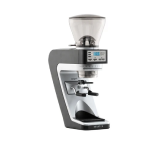
This is why the Fiorenzato All Ground Sense Dark-T, built around 64mm burrs, makes sense for a serious home setup or a low-volume specialty counter or decaf option, while something in the 80mm range like the Mahlkonig E80W GBS is built for the higher throughput a busier bar demands. Right-sizing burr capacity to your actual volume means consistent grind quality whether you're making one shot or fifty, without paying for headroom you'll never use.

Volumetric and auto-volumetric machines are built around a specific assumption: that the dose hitting the basket is consistent shot after shot. If your grinder dribbles out an inconsistent amount, even a perfectly tuned machine will produce uneven extractions.
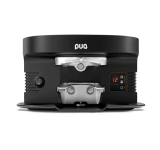
Pairing a single-dose grinder with an auto-tamper, like the Gen 6 Mini auto tamper, removes one of the biggest sources of shot-to-shot variation in any setup. The grinder controls dose consistency, the tamper controls puck density consistency, and the machine is left to do the one job it's actually built for: extraction. This is the difference between a barista fighting their equipment every single shot and a barista who can focus entirely on dialing in flavor.

Stepped grinders move in fixed increments. Stepless grinders allow infinitely fine adjustment. Buyers often pick based on price alone and end up with adjustment resolution that doesn't actually fit how they brew.
If you're chasing a specific extraction window with a pressure-profiling machine, fine stepless adjustment matters a great deal, since even a small grind change can shift the curve meaningfully. The Macap MI20 Luxe and the Macap Supra G Series both offer the kind of fine control that pairs well with machines built around manual or semi-manual extraction. Not only can you make major adjustments with numbers, you can use the knob to make micro adjustments seamlessly. You spend less time hunting for the right setting and more time actually tasting the difference one click makes.

Flat burrs and conical burrs produce genuinely different particle distributions, and pairing the wrong geometry with your brewing goals leaves flavor on the table no matter how good the machine is.
Flat burrs, like those in the Mahlkönig E65W tend to produce a more even particle size with a brighter, more defined flavor profile, which pairs well with machines built for clarity and precision, like single-group profiling machines. It's a pairing decision worth thinking through rather than defaulting to whatever's on sale. Matching burr geometry to your flavor goals means your grinder is actively working toward the cup you want, not just grinding coffee to a number on a dial.

Mobile carts and small-footprint cafes feel this the most. When counter space is limited and every piece of equipment has to earn its place, a mismatched grinder and machine wastes both space and money. Compact, high-capacity grinders paired with single-group commercial machines are the most space-efficient setup available right now.
Home enthusiasts upgrading from a starter setup run into it too. If you've outgrown an entry-level machine and you're investing in something with real pressure profiling or programmable extraction, pairing it with an entry-level grinder undercuts the upgrade. The grinder should be upgraded in step with the machine, not treated as a separate decision made later.
And anyone running back-to-back service needs to think about it from day one. Cafes, trailers, and home setups serving guests need grind speed and dose consistency that can keep up with demand, not just on a quiet Tuesday morning but during the actual rush.
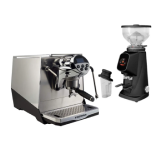
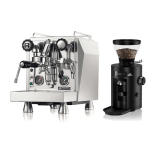
This is also exactly why bundle pricing exists. When PCG pairs a machine and grinder together, like the Rocket Bicocca + Macap Leo 55 Bundle, or the Sanremo D8 + Mahlkonig E65W GBS Bundle it's not arbitrary. These pairings reflect genuine compatibility in burr size, dosing behavior, and grind speed relative to the machine they're sold alongside. Buying the pair together usually works out to meaningfully better pricing than buying each piece separately and guessing at compatibility yourself.
If you're shopping a specific machine, it's worth checking whether it's already offered in a bundle before buying the grinder separately. The savings are real, and the pairing logic has already been done for you.

A great espresso machine sets the ceiling for what your shots can be. Your grinder decides how close you actually get to that ceiling on any given morning. Burr size, dosing consistency, grind speed, adjustment granularity, and burr geometry all play a role in whether your setup performs as one cohesive system or as two expensive pieces of equipment working against each other.
If you're upgrading either piece, it's worth thinking about the other one at the same time. The right pairing makes the entire setup better than the sum of its parts, and in several cases right now, it also means a meaningfully better price.
Have questions about which grinder actually fits your machine, your volume, or your brewing style? The Pro Coffee Gear team is happy to walk you through it. Call (512) 273-6324 or book a consultation with our team.