Commercial Coffee Grinders

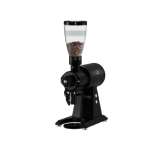
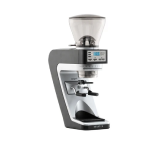
Your espresso is only as good as your grind. A commercial coffee grinder built for cafe use delivers the speed, consistency, and durability that home grinders cannot sustain through an 8-hour service. Pro Coffee Gear carries commercial espresso grinders and commercial coffee grinders from leading professional brands, as well as renewed and open-box options that are commercially inspected and ready for service. Every purchase includes free shipping, and our team offers free expert consultation to help you match the right grinder to your machine, menu, and daily volume. Visit our Austin showroom to see grinders in person.

The right commercial coffee grinder depends on four factors: your espresso machine, your daily volume, your brew methods, and your burr preference.

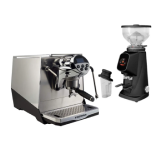
Match throughput to machine output. A 1-group commercial espresso machine typically pulls 80 to 120 shots per day. Your grinder should be rated for at least that volume without overheating or losing grind consistency under sustained load.

Flat burr vs. conical burr. Flat burr grinders produce a uniform, dense grind particle distribution, which many baristas associate with clarity and sweetness in espresso. Conical burr grinders run at lower RPM, generate less heat during grinding, and typically produce a slightly more complex flavor profile. Both can produce excellent espresso; the difference is subtle and preference-driven.

Hopper-fed vs. single-dose. For high-volume cafes, a hopper-fed grinder with programmable dosing speeds up workflow significantly. Single-dose grinders offer more flexibility for menus with multiple coffee origins or frequent recipe changes.

Dedicated espresso vs. allround. If your menu includes espresso-based drinks and batch brew, consider an allround grinder or a second dedicated unit for filter. A well-matched grinder is also worth pairing with espresso accessories to complete your bar setup.

Our team can pair you to the right grinder for your setup during a free consultation.

What commercial coffee grinder should I buy for my cafe?

Start by matching grinder capacity to your daily shot volume. For up to 100 drinks per day on a 1-group commercial espresso machine, a mid-range commercial espresso grinder with programmable dosing covers most small cafe needs. For higher volume or specialty menus, our team can recommend specific models during a free consultation based on your machine, coffee, and workflow.

How does a commercial coffee grinder work?

A commercial coffee grinder uses two rotating burrs to crush whole beans into uniform particles. The gap between the burrs controls grind size: tighter for espresso, wider for filter or batch brew. Commercial burr grinders are engineered for consistent particle size distribution, which directly controls extraction rate and espresso flavor.

What is the difference between flat burr and conical burr grinders?

Flat burr grinders use two parallel disc-shaped burrs and produce highly uniform particle sizes, often associated with clarity and sweetness in espresso. Conical burr grinders use a cone-shaped burr inside a ring burr, run at lower RPM, generate less heat, and tend to produce a slightly broader particle distribution.

How often should commercial coffee grinder burrs be replaced?

Most commercial grinder manufacturers recommend replacing burrs every 500 to 1,000 kilograms of coffee ground, depending on burr material and grinder model. Worn burrs produce uneven particle sizes, leading to inconsistent extraction. Many cafes track replacement by cumulative weight of coffee processed rather than by calendar time.

What is the difference between a commercial coffee grinder and a home grinder?

Commercial coffee grinders are built for continuous operation across an 8-hour service, with hardened steel burrs, high-torque motors, and components rated for hundreds of kilograms of coffee per year. Home grinders are designed for occasional use and lack the thermal management and build quality required for a professional cafe environment.

Can one commercial grinder support multiple brew methods?

Some commercial grinders are designed as allround grinders, with a wide enough grind range to cover espresso and filter brew methods. For cafes running both espresso and batch brew, an allround grinder or two dedicated machines is the better approach than adjusting a single espresso-dedicated unit repeatedly throughout the day.